Beginner guide
How to Tie a Karate Belt: 6 Steps and the Right Length
Tie your karate belt in 6 steps with a flat square knot, check that both ends hang even, and size a new belt with the Tokaido, Century and Shureido charts.
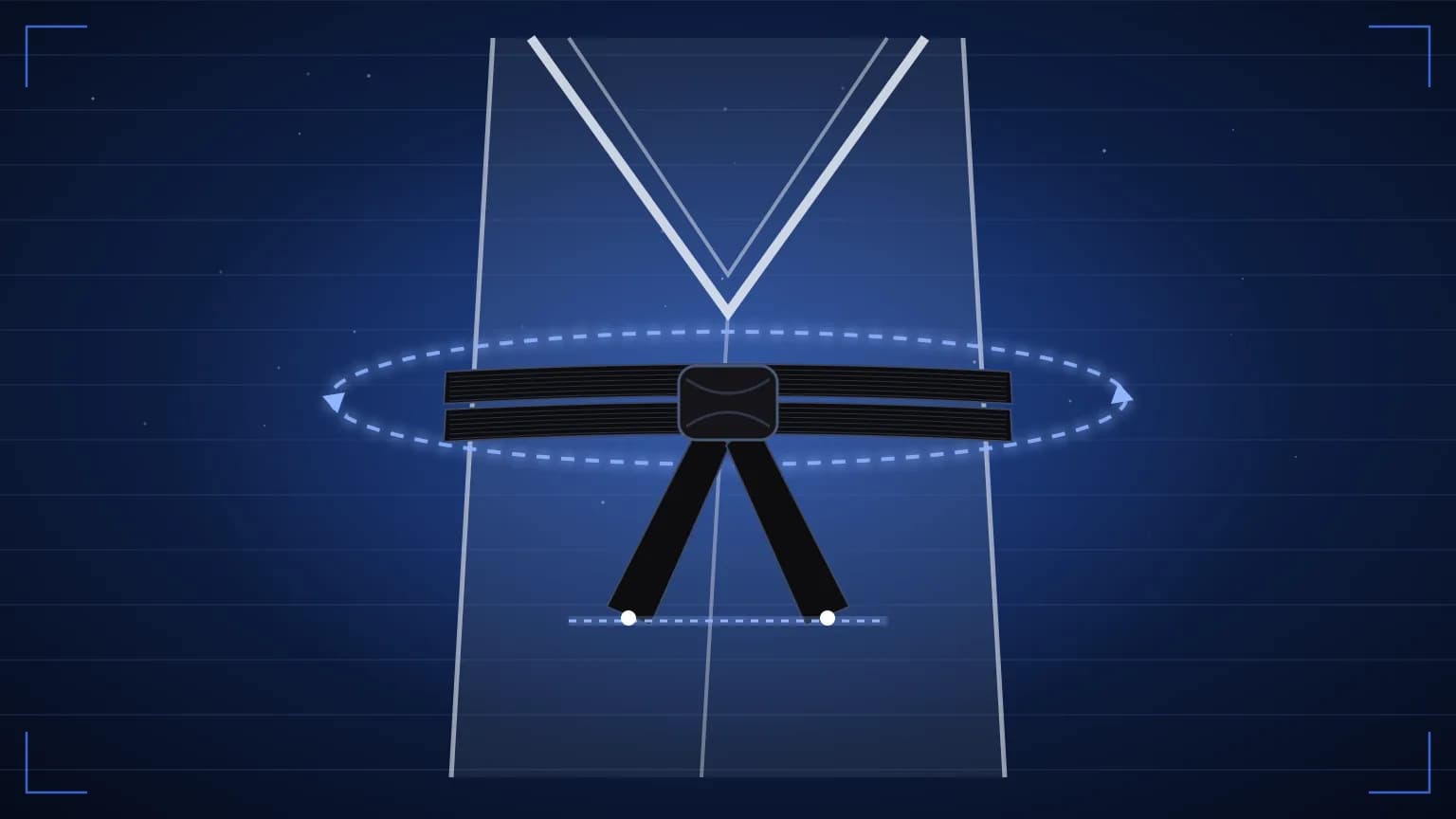
To tie a karate belt, find its middle, hold the middle on your stomach, wrap both ends around your back and bring them to the front, then cross the right end over the left and tuck it up under both layers. Finish with a square knot, right over left and then left over right, and pull until the knot lies flat with both ends hanging level.
Level ends matter in competition. The World Karate Federation asks competition belts to leave 15 cm free on each side of the knot, and a belt that slides off your hips during a kata counts as a foul. Here is the whole method, the mistakes that make a knot twist, and how long your belt should be.
Tie your belt in 6 steps
Tie your jacket's ties first, so the belt closes over a jacket that cannot shift.
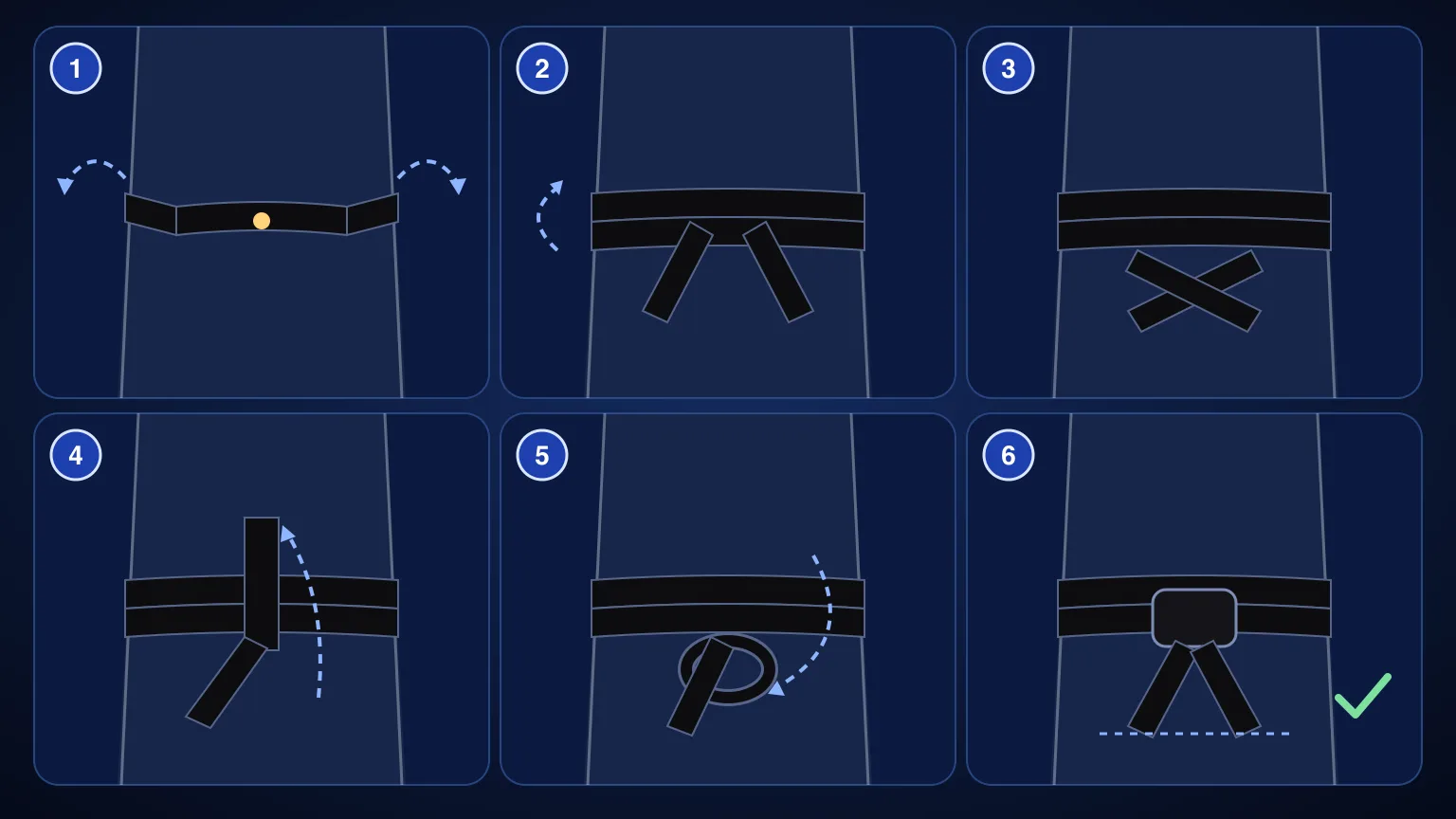
- Find the middle. Fold the belt in half so the two ends meet, and pinch the fold. Put the pinched middle flat on your stomach, just below your navel, with the label facing out if your belt has one.
- Wrap both ends around your back. Take one end in each hand, pass them behind you, cross them over each other at the small of your back, and bring each end back to the front on the opposite side. Keep both layers flat against your gi: a twist at the back shows as a bulge at the front.
- Cross right over left. Lay the end in your right hand over the end in your left hand, in front of the middle of your stomach.
- Tuck it up under both layers. Push that top end up behind both layers of the belt, from the bottom, and pull it out at the top. You now hold one end hanging from the top and one end hanging from the bottom.
- Tie the square knot. Bring the top end down over the bottom end, then thread it up through the loop you just made. This half of the knot goes left over right, the mirror of step 3, and that mirror is what keeps the knot flat.
- Pull level and tight. Pull both ends out to the sides at the same time, then check that they hang the same length. If one end is longer, untie and start again from step 1 with the middle placed more carefully.
Practise it three times in front of a mirror before your next class. Tie it again after every break in training, because a belt that loosens during kihon slides down your hips fast. To see what a full class of kihon, kata and kumite burns, run it through the karate calories burned calculator.
Tie a child's belt from the front
Small children cannot tie their own belt for the first months, so you tie it facing them. Everything is mirrored, which is where most parents go wrong.
- Kneel in front of your child and hold the middle of the belt on their stomach.
- Pass both ends around their back and bring them to the front, crossing them flat behind.
- Cross the end on your left over the end on your right. Your left is your child's right, so this matches step 3 above.
- Tuck that end up under both layers, then finish the square knot with the other end on top, so the two halves cross in opposite directions.
- Pull both ends level, then ask your child to bend and jump twice. If the belt slips, tie it again tighter.
Teach the steps out loud while you tie them. By the time your child grades for the first time, ask them to tie it for you, and plan that first test together with our belt test preparation guide.
Check the finished knot
Look down at your belt and run through four checks:
| Check | What you want | What it tells you if it fails |
|---|---|---|
| Knot shape | A flat knot, wider than it is tall | A vertical knot means both halves went the same way, a granny knot |
| Ends | Both ends hang the same length | You placed the middle off centre in step 1 |
| Layers | Two flat layers with no twist at the back | You crossed the ends loosely behind you |
| Tightness | The belt stays on your hips through a full kata | You did not pull level in step 6 |
At a WKF event the rule is concrete: the red or blue competition belt must be around 5 cm wide and long enough to leave 15 cm free on each side of the knot, but no longer than three-quarters of your thigh. Grade belts are not worn during a bout. The same rules measure your jacket with the belt tightened around the waist: it must cover your hips and end no lower than three-quarters of your thigh, and a jacket without ties is not allowed.
Fix the 5 mistakes that ruin the knot
- The knot stands up vertically. You tied a granny knot, with both halves crossed the same way. Fix it at step 5: if you crossed right over left first, the second half goes left over right.
- One end hangs longer. The middle was not on your stomach in step 1. Fold the belt again and pinch the true middle before you start.
- The belt twists at the back. Cross the ends flat behind you and pull each one forward along your hips, level with your waist.
- The knot slips during class. You tucked the end under one layer instead of both in step 4. Push it up behind both layers so the knot locks the whole belt.
- The ends dangle to your knees. Your belt is too long for you. Size it with the charts below, and remember the WKF limit of three-quarters of your thigh for competition.
Pick the right belt length
Karate belts come in numbered sizes, and each maker sets its own lengths. Measure your waist where the belt sits, then use your maker's chart.
Tokaido gives a formula for a standard-width black belt: your waist in centimetres times 2, plus 110 to 120 cm. A waist of 80 cm gives 270 to 280 cm, which sits between Tokaido size 4 (265 cm) and size 5 (280 cm). For an extra-wide belt, add 120 to 130 cm instead, and Tokaido suggests going one size longer so the embroidery does not disappear into the knot.
| Tokaido black belt size | Length | Century size | Your waist | Century double-wrap length |
|---|---|---|---|---|
| 2 | 235 cm (92 in) | 2 | 23 to 24 in | 92 in |
| 3 | 250 cm (98 in) | 3 | 25 to 28 in | 96 in |
| 4 | 265 cm (104 in) | 4 | 29 to 32 in | 104 in |
| 5 | 280 cm (110 in) | 5 | 33 to 36 in | 112 in |
| 6 | 295 cm (116 in) | 6 | 37 to 40 in | 120 in |
| 7 | 310 cm (122 in) | 7 | 41 to 45 in | 130 in |
Century builds its chart around a 12-inch tail on each side and tells you to go up a size for a heavy-core or 2-inch-wide belt, because it forms a bigger knot. Shureido lists its belts in half sizes from 3 (250 cm) to 7 (330 cm), in 10 cm steps.
For children, Century's chart starts lower: a waist up to 20 inches takes size 0, an 85-inch belt, and a 21 to 22-inch waist takes size 1, an 88-inch belt. If you want longer ends than Century's 12 inches, add the extra inches per end, times two: 18-inch ends mean a belt 12 inches longer than the chart. Century notes that many brown and black belts want their belts a little longer.
Work one example. Your waist measures 32 inches. Century puts you in size 4, a 104-inch belt. In centimetres your waist is about 81 cm, and Tokaido's formula gives 272 to 282 cm, between its size 4 and size 5. If you like longer ends, take the size 5.
Your uniform needs sizing too: check your jacket and trousers with the karate gi size calculator before you order both together.
Follow the competition rules on belts
Tournament rules turn belt habits into penalties:
- Kumite: you wear the WKF-approved red (aka) or blue (ao) belt the draw gives you, with no embroidery beyond the maker's label, under Article 2.2.1 of the WKF Kumite Competition Rules.
- Kata: the same belt rules apply, and the WKF Kata Competition Rules list a belt coming loose until it comes off your hips as a foul (Article 5.7) and a belt falling off during the performance as grounds for disqualification (Article 5.8).
- Japan: the Japan Karatedo Federation's 2017 rule changes also capped the belt at three-quarters of the thigh, and the Japan Karate Association marks one competitor with a thin red band tied around the waist.
Before your first event, learn how bouts are scored in our karate tournament scoring guide, and see the belts you will climb through in the karate belt order guide.
Care for your belt
Makers disagree on washing. Tokaido recommends hand-washing a dirty belt in cold water with a mild detergent and hanging it to dry straight away. Arawaza does not recommend washing belts at all and says its belts are colour fast. Follow the label on your own belt, and never put a belt in a tumble dryer if the maker says to line dry.
Get quick answers
Where should the knot sit on a karate belt?
In the middle of your stomach, just below your navel, with both ends hanging the same length. Start from the true middle of the belt in step 1 and the knot lands there on its own.
How long should the ends of a karate belt hang?
Under WKF rules, at least 15 cm on each side of the knot and no lower than three-quarters of your thigh. Century sizes its belts around a 12-inch tail on each side.
Why does my karate belt knot stand up?
You crossed both halves of the knot the same way, which makes a granny knot. Cross right over left in step 3, then left over right in step 5, and the knot lies flat.
Does the karate belt go over the jacket?
Yes. Tie the jacket's ties first, then wrap the belt over the jacket at your waist. WKF rules even measure your jacket length with the belt tightened around it.
What is the difference between a single-wrap and a double-wrap belt?
A double-wrap belt goes around your waist twice, which is the method in this guide. A single-wrap belt goes around once, so it is much shorter: Century lists its size 3 at 96 inches for a double wrap and 69 inches for a single wrap.
How do I know my karate belt size?
Measure your waist where the belt sits. Tokaido's formula is your waist in centimetres times 2, plus 110 to 120 cm. Century's chart puts a 29 to 32-inch waist in size 4, a 104-inch belt.
Should you wash your karate belt?
Follow your maker. Tokaido recommends hand-washing a dirty belt in cold water with mild detergent and line drying it. Arawaza does not recommend washing belts.
Check the sources
- World Karate Federation, Kumite Competition Rules, Rules Version 2026.01, Article 2.2.1
- World Karate Federation, Kata Competition Rules, Rules Version 2026.0, Articles 2.2.1, 5.7 and 5.8
- Japan Karatedo Federation, summary of competition rule changes, 2017
- Japan Karate Association, Tournament Rules and Regulations, 2025
- Tokaido, how to order a black belt and choose its length
- Tokaido, Champion BLC black belt sizes
- Tokaido, uniform and black belt care
- Century Martial Arts, belt size charts
- Shureido, black cotton belt sizes
- Arawaza, product care