
Training
How to Film and Analyse Karate Technique Video
Film useful karate video, review one observable detail at a time and turn the clip into a focused question for your next dojo session.
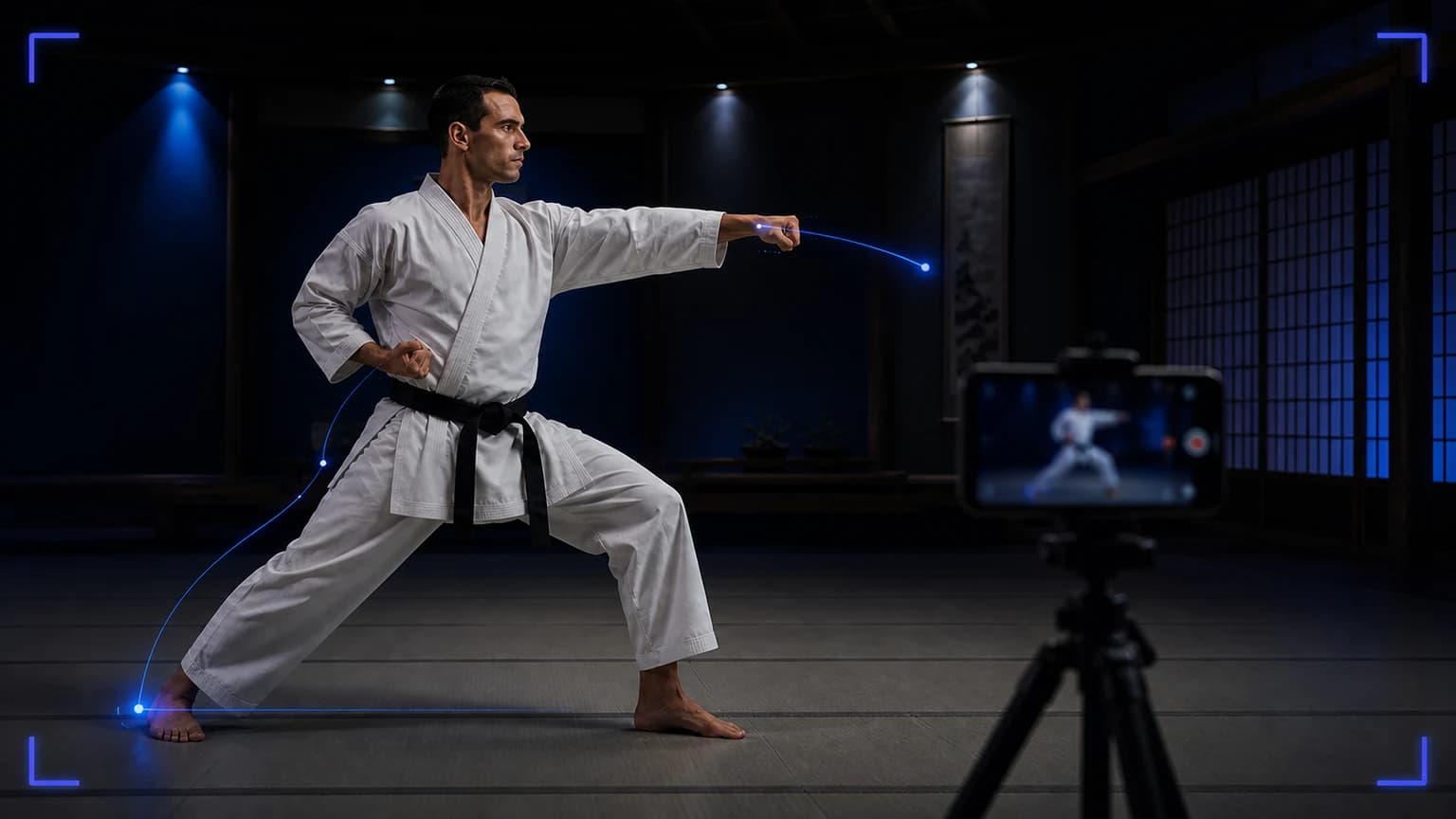
Film your full body from a stable position, keep the camera angle and starting mark consistent, and review the first observable change—not the most dramatic frame. Watch the complete repetition at normal speed first. Then compare two or three controlled attempts and take one precise question to your instructor.
Set up a clip you can actually compare
Choose one task before you press record: a kata turn, a stance transition, one kihon combination or a controlled kumite entry. Clear enough space to complete it without adapting around the phone. Place the camera around waist-to-chest height and far enough away to keep your hands, feet and finishing position inside the frame. Use a tripod or a solid shelf; a moving camera can make a stable stance look unstable.
Record landscape video when you need to show travel across the floor. Use normal room lighting and avoid a bright window behind you. Put a small removable marker on the floor for your start position and another for the camera. Those two marks make the next clip more comparable than a higher frame rate or a cinematic angle.
Ask before you record anyone else. Avoid capturing faces, voices, children, licence plates or a recognisable dojo location when you do not need them. Follow your club's filming policy and get a training partner's clear consent before you upload or share a clip.
Choose the angle that answers your question
No single view settles every technical question. Match the angle to the detail you want to inspect:
- Front view: use it for lateral balance, stance width, guard position and whether your line drifts sideways.
- Side view: use it for stance length, posture, hip travel, reach and whether your base arrives before the technique.
- Diagonal view: use it when a turn, combination or kumite entry disappears in a pure front or side view.
- Second angle: add one only when the first view cannot answer the question. Do not collect five angles of an unfocused repetition.
If you practise kata, keep the whole embusen in frame when possible. If your room is too small, record the section around the problem and state that limitation. Our kata performance guide explains how to isolate a section without changing the required sequence. For stance questions, use the checkpoints in the karate stance guide instead of judging depth from one flattering frame.
Review in three passes
1. Watch at normal speed
Do not pause. Ask whether the movement keeps its intended rhythm, direction and control. Note the first moment that makes you uncertain. A slow-motion frame can show where a foot landed, but it cannot show whether you chose the right distance or maintained the required tempo.
2. Find the first visible change
Now scrub back to the earliest observable difference between attempts. Write a neutral observation: “my rear heel lifted before the turn,” “my stance narrowed after the second step,” or “I reached before I moved my base.” Avoid a diagnosis such as “my hip is weak.” The clip shows positions and timing; it does not establish why they happened.
3. Test one cue
Choose one cue that you can apply safely in the next short set. Repeat the same task two or three times from the same marks. If the cue improves one feature but disrupts balance, sequence or control, stop adding speed and ask your instructor to inspect the trade-off.
Turn the clip into a useful coaching question
Show your instructor a short before-and-after pair rather than ten unrelated repetitions. State the style, kata or drill, the intensity and the rule set that applies. Then ask one answerable question: “Does my stance narrow before I turn, or does this camera angle create that impression?” This gives your instructor evidence and context without asking the video to replace technical judgment.
When you prepare for a grading, confirm the required version and terminology with your dojo first. Use the planning sequence in our belt-test guide and follow the official materials for your organisation. Competition athletes should also check the current World Karate Federation rules and the rules for their specific event.
Keep the review safe and honest
Use video to inspect visible movement, not to diagnose pain or promise injury prevention. Stop the drill if you feel pain, dizziness or symptoms after contact. Speak with a qualified health professional about symptoms and with a qualified coach about safe technical changes. Do not use a score, one frame or an app response to clear yourself for training.
Method and sources
We built this guide from the documented filming-and-review workflow on the official App Store listing, current public WKF rules and a live review of pages that rank for karate video-analysis searches on 15 August 2026. We separated setup advice from product claims, rejected unsupported accuracy and injury claims, and kept style-specific decisions with the reader's instructor.