
Kata
Bassai Dai Kata: All 42 Moves, Meaning and Bunkai
Learn Bassai Dai step by step: all 42 JKA moves with stance and tempo, what the name means, how Shito-ryu differs, the bunkai and the faults graders mark.
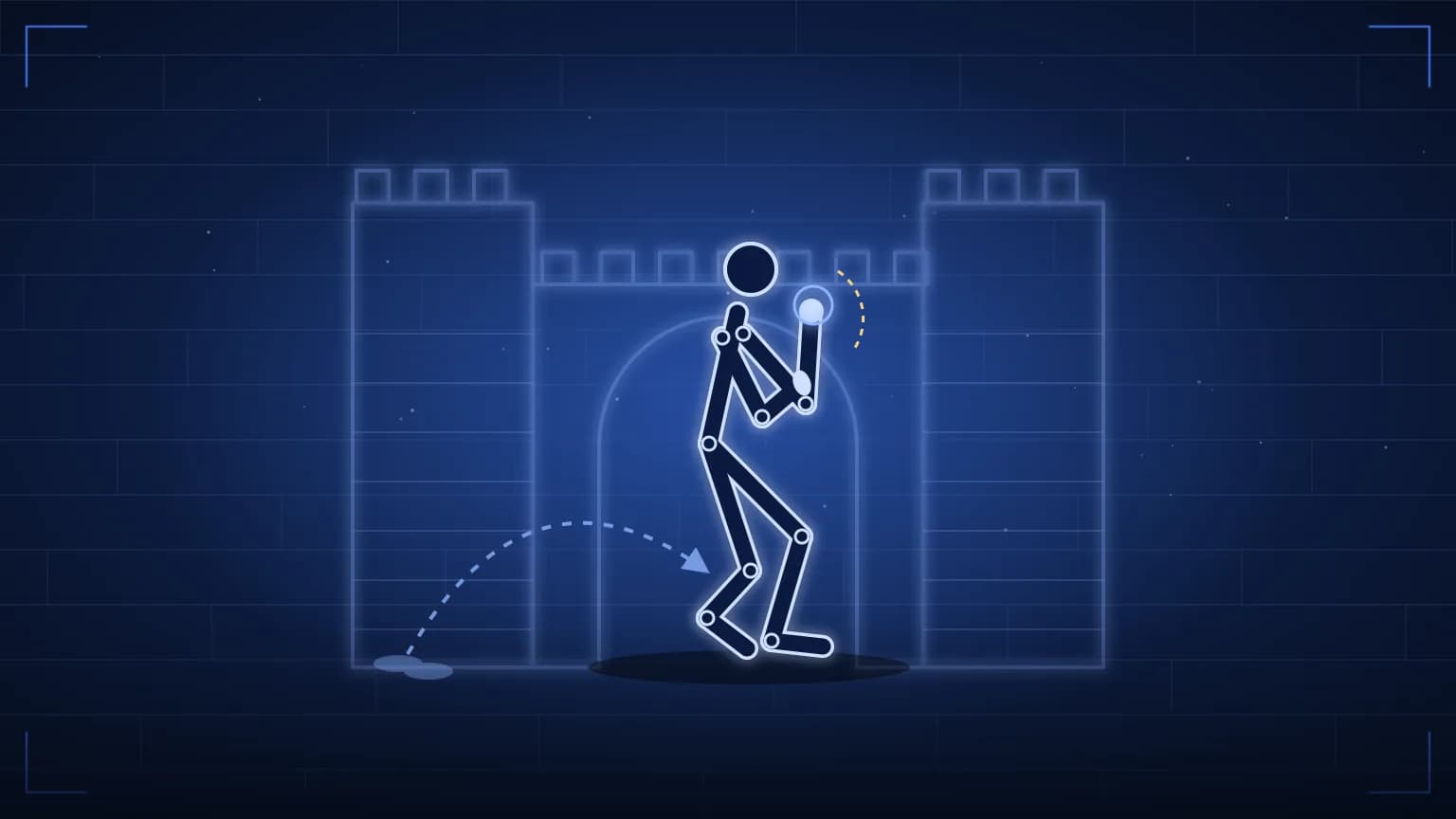
Bassai Dai is the Shotokan kata the Japan Karate Association sets for 1st kyu, the last grade before black belt, and one of four kata you may choose at 1st dan. The JKA counts 42 movements that open with a leap forward into a crossed stance and a braced block, and JKA count sheets mark kiai on move 19, the grasp and stamping kick, and move 42, the last knife-hand block.
The name means breaking into a fortress, and the kata moves like it: switching blocks that turn a weak position into a strong one, then grabs, stamps and two-fisted punches. Below you get every move with its stance and tempo, the Shito-ryu differences, the bunkai and the faults graders mark.
Read what the name means
The Japan Karatedo Federation writes the name 抜塞大. The first character means to pull out or break through, the second a fortress or barrier, and dai means major. The English Shotokan Karate Association translates it "To Storm a Fortress, Major" and prints the first character as 披, so you will meet both spellings. The JKA's Technical Manual for the Instructor gives the meaning as "penetrating the fortress of an enemy" and asks for spirit, power and momentum, with double blocks where "disadvantaged positions become advantage positions."
Bassai Sho, the minor version, has 27 movements and, in the same manual, defends against a face-level stick attack. You learn it later: the ESKA places it in its shodan band.
Check the facts before you start
| What you need to know | Bassai Dai |
|---|---|
| Movements | 42 in the JKA count, 46 in the English Shotokan Karate Association count |
| Kiai | Move 19 (stamping kick with a two-hand pull) and move 42 (last shuto-uke) on JKA count sheets |
| Slow moves | 9, 18, 25, 27, 34, 36 and 41 |
| JKA grade | 1st kyu; at 1st dan you choose Bassai Dai, Kanku Dai, Enpi or Jion |
| JKA tournaments | On the designated intermediate (Sentei) list with Kanku Dai, Enpi and Jion |
| WKF official kata list | No. 6 |
| Japan Karatedo Federation | No. 1 on the Shotokan favorite kata list, and a first designated kata for Shito-ryu |
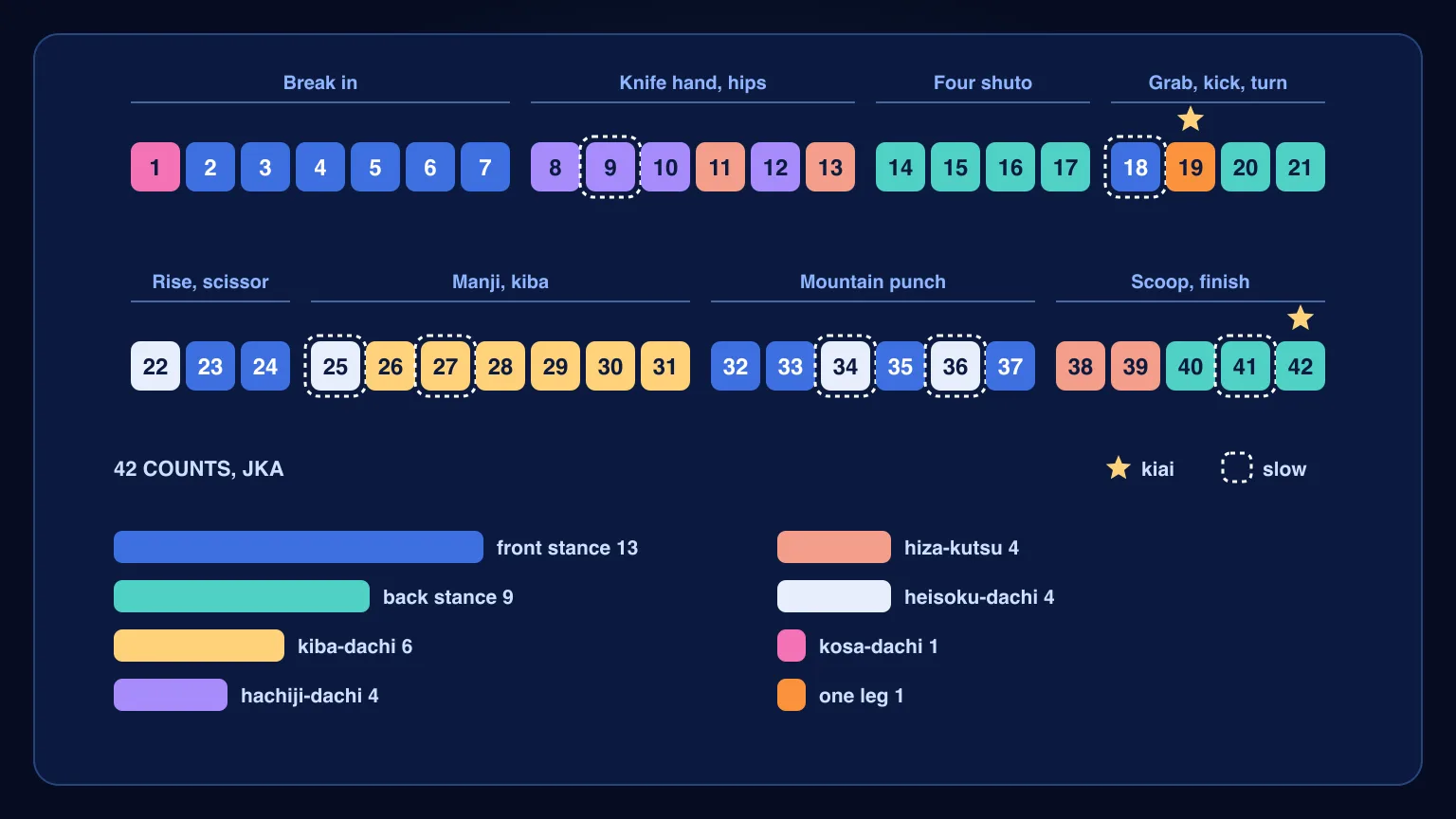
Read the map before you learn the moves. Thirteen of the 42 counts sit in front stance, nine in back stance and six in kiba-dachi, and the seven slow moves fall in clusters. The JKA tournament rules score "change in the speed of the techniques" as one of the three key elements of kata, so the slow moves are where you win or lose marks.
Perform all 42 moves step by step
Start in musubi-dachi, bow, announce "Bassai Dai," and step into yoi in heisoku-dachi, feet together, with your left hand wrapped over your right fist in front of you. Call the direction you face at the bow "the front." The counts follow the JKA 42-count sheet.
Break in and switch blocks (phrase 1, moves 1 to 7)
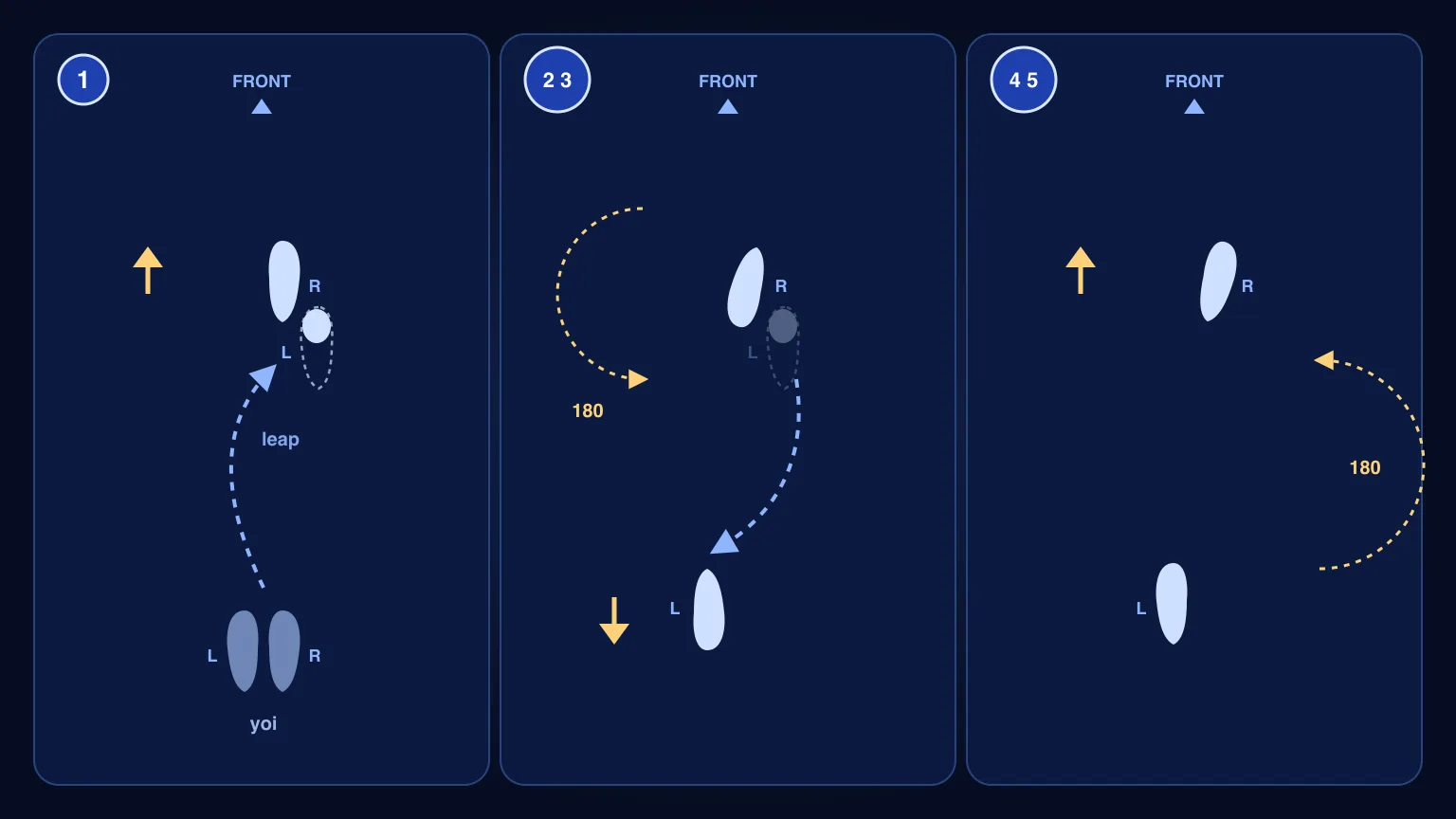
- Raise your right knee and leap forward, landing on your right foot with your left foot tucked behind it in kosa-dachi, the crossed stance. Block right chudan uchi-uke with your left palm bracing your right forearm (soete uchi-uke).
- Turn your head left and reach your left foot back toward your start, turning 180 degrees into zenkutsu-dachi, front stance, facing the back. Cross your left arm under your right and block left chudan uchi-uke.
- Block right chudan uchi-uke in place, turning your hips hard so your right shoulder comes forward (gyaku-hanmi). Keep the full length of the stance.
- Pivot 180 degrees to face the front in front stance with your right foot forward, and block left chudan soto-uke.
- Block right chudan uchi-uke in place.
- Draw your right foot to your left as you turn 90 degrees to the right, knees bent, and scoop low with your right arm (gedan sukui-uke). Raise the right fist beside your head and step your right foot out into front stance with a right chudan soto-uke.
- Block left chudan uchi-uke in place, hips turned.
Turn your hips through blocks and punches (phrase 2, moves 8 to 13)
- Draw your left foot in and turn to face the front in hachiji-dachi, the natural stance, with both fists at your right hip, left fist on top.
- Slowly open your left hand and circle it out into a vertical knife-hand block (tate-shuto-uke) at chest height.
- Punch right chudan choku-zuki on the spot.
- Block right chudan uchi-uke as you turn your hips left, your left knee bending in (hiza-kutsu) and your right leg straightening.
- Punch left chudan choku-zuki, back in hachiji-dachi.
- Block left chudan uchi-uke as you turn your hips right, right knee bending in.
Block with four knife hands (phrase 3, moves 14 to 17)
- Step your right foot forward into kokutsu-dachi, back stance, and block right shuto-uke.
- Step your left foot forward and block left shuto-uke.
- Step your right foot forward and block right shuto-uke.
- Step your right foot back and block left shuto-uke.
Grab, stamp and turn (phrase 4, moves 18 to 21)
- Slide your right foot into a short front stance. Reach your right hand forward palm up under your left hand, then circle both hands slowly down to the right into a two-hand grasp (ryosho tsukami-uke).
- Raise your right knee inside the triangle of your arms and stamp a low side thrust kick (gedan sokuto-kekomi) as you pull both fists to your right hip. Kiai.
- Set your right foot down where you kicked and turn 180 degrees to face the back in back stance. Block left shuto-uke.
- Step your right foot forward and block right shuto-uke.
Rise, strike and punch (phrase 5, moves 22 to 24)
- Draw your right foot back to your left into heisoku-dachi, open both hands palm up at your waist, and rise as you sweep both forearms up into morote age-uke, closing the fists.
- Raise your right knee, open your arms and step your right foot forward into front stance as both hammer fists swing in from the sides at chest height (ryo-kentsui hasami-uchi).
- Push off your left foot and slide half a step forward (yori-ashi), punching right chudan zuki.
Drop from manji-uke into horse stance (phrase 6, moves 25 to 31)
- Look left behind you and turn 180 degrees to your left, sweeping your left open hand high (nagashi-uke) as your right knife hand drives low. Then draw your left foot to your right into heisoku-dachi, turn your hips 90 degrees right, and slowly form manji-uke: right forearm high to the side, left arm low.
- Swivel 180 degrees to your left on your left foot, raise your right knee and stamp into kiba-dachi, horse stance, with a right gedan-barai.
- Look left and slowly extend your open left hand into a hooking block with the back of the hand (kake-uke), right fist at your hip. Breathe in.
- Kick a right crescent kick (mikazuki-geri) into your left palm, turning 180 degrees on your left foot, land in kiba-dachi and drive your right elbow forward into the same palm (mae-empi).
- Block right gedan-uke with your left forearm across your chest.
- Block left gedan-uke with your right forearm across your chest.
- Block right gedan-uke with your left forearm across your chest.
Throw three mountain punches (phrase 7, moves 32 to 37)
- Look right, draw your right foot back a little into a short front stance, and bring both fists to your left hip.
- Punch yama-zuki, the mountain punch: left fist to the face, right fist low, both fists in one vertical line and your upper body leaning forward.
- Draw your right foot to your left into heisoku-dachi and slowly bring both fists to your right hip.
- Raise your left knee, stamp forward into front stance and punch yama-zuki, right fist high and left fist low.
- Draw your left foot to your right into heisoku-dachi and slowly bring both fists to your left hip.
- Raise your right knee, stamp forward into front stance and punch yama-zuki, left fist high and right fist low.
Scoop and finish (phrase 8, moves 38 to 42)
- Pivot on your right foot and swing your left leg through 90 degrees, scooping low with your right arm (gedan sukui-uke), left knee bent in.
- Pivot on both feet to the right and scoop low with your left arm.
- Look 45 degrees to the right, draw your left foot to your right and step your right foot out on that diagonal into back stance with a right shuto-uke.
- Look 90 degrees to the left and slowly slide your right foot back through 90 degrees, staying in back stance and keeping your upper body exactly as it is (jotai sonomama).
- Bring your right foot under your right shoulder, step your left foot out on the other diagonal into back stance and block left shuto-uke. Kiai.
Return to yoi with your left hand wrapped over your right fist, then close to musubi-dachi and bow.
Compare Shotokan and Shito-ryu versions
Each federation describes the kata in its own words. The JKA manual asks for "spirit, power and momentum." The JKF dictionary, writing about the Shito-ryu kata, asks for light, quick movement with sharp changes between techniques, a clear use of strong and soft, and swift finishing techniques. Expect the Shito-ryu version to look lighter and quicker, and the Shotokan version heavier and more driving.
The style lists show how much more Bassai Shito-ryu keeps. The JKF's favorite kata lists give Shotokan two versions, Bassai Dai and Bassai Sho. Shito-ryu has four: Bassai Dai, Bassai Sho, Tomari Bassai and Matsumura Bassai. Wado-ryu lists one, plain Bassai. The WKF official list carries eight Bassai or Passai entries, from no. 5 Bassai to no. 97 Tomari Bassai, and Bassai Dai appears once, as no. 6.
That single number matters if you compete. Under Article 5.3.2 of the 2026 WKF Kata Competition Rules, judges permit "slight variation as taught by the Athlete's style," so a Shotokan and a Shito-ryu athlete can both announce no. 6 and perform their own versions. Within Shotokan alone the counts differ, 42 at the JKA and 46 at the ESKA. Before you learn from any video, check four things with your instructor: the total count, the depth of your stances, where the kiai fall, and how the opening leap lands.
Read the bunkai of the key sequences
The JKA manual's second line on Bassai Dai is your bunkai key: double blocks that turn a bad position into a good one. Test each reading below slowly with a partner and your instructor, and use the actual movements of the kata, as the WKF rules require for team bunkai.
| Moves | What you do | A common reading |
|---|---|---|
| 1 | Leap in with a braced block | Close the distance and jam an attack before it lands |
| 2 to 7 | Switching uchi-uke and soto-uke | Deflect a strike, then turn the hips to clear a second one or break a grip on your arm |
| 9 to 13 | Slow knife hand, punch, hip-turn block | Catch and control the arm, hit, then twist out of a hold |
| 18, 19 | Two-hand grasp, low side kick | Seize the attacking arm, pull, and stamp the knee |
| 22 to 24 | Rising block, scissor hammer fists, slide and punch | Break a two-hand grab or choke upward, strike both sides of the ribs, then drive through |
| 27, 28 | Hooking block, crescent kick into your palm, elbow | Catch the arm, kick it or the body, finish with the elbow |
| 38, 39 | Low scooping blocks | Scoop a kicking leg and lift it to unbalance |
Fix the faults graders mark
The JKA manual's examination checklist asks for flat soles, level hips, simultaneous hands and feet, proper aim, clear changes of speed, the correct order of moves and a return to your starting point. These are the places Bassai Dai breaks each one.
| Where | The fault | The fix |
|---|---|---|
| Move 1 | You land on two feet with a gap between them | Land on the right foot and tuck the left in behind the heel, knees bent |
| Moves 3, 4, 7 | You shorten the front stance to turn the hips | Keep the full stance and turn from the hips; the length stays the same |
| Move 9 | The knife hand snaps out | Take three slow seconds and breathe in through the whole circle |
| Moves 14 to 17 | Weight drifts forward in back stance | Keep about two-thirds of your weight on the back leg |
| Move 19 | The kick lands high and the hands pull late | Aim the kick at knee height and pull both fists on the same beat |
| Moves 26 to 31 | Knees cave in during kiba-dachi | Push both knees out over the toes with heels flat |
| Moves 33, 35, 37 | The two fists drift apart | Stack the fists in one vertical line, top fist at face height |
| Move 41 | Your upper body moves with the foot | Move only the right foot and keep the upper body fixed |
The JKA tournament rules deduct 0.1 to 0.3 if you finish more than one step from your start, and they also deduct for a pause without reason or a movement out of order. Mark your start with tape.
Build Bassai Dai over four weeks
At 42 counts, Bassai Dai runs about twice as long as Heian Sandan. A 2009 study of six kata and six kumite world champions in a simulated competition recorded heart rates of 174 to 187 beats per minute, and a 2012 study measured blood lactate up to 8.1 mmol/L after runs of Heian Nidan, a kata of about 30 seconds. Build length before full intensity.
- Week 1. Learn phrases 1 to 3 and run moves 1 to 17 slowly five times a session.
- Week 2. Add phrases 4 and 5, with ten slow kicks per leg for move 19 first.
- Week 3. Add phrases 6 to 8 and run the full kata three times at moderate speed, resting a minute or two between runs.
- Week 4. Run it four times at full speed, holding all seven slow counts, and film your second run.
Deep stances load your knees and hips. A 2011 study of a national team linked kata competitors' flexibility to their "exceptionally low postures," though the flexibility edge fell just short of statistical significance. Never force depth through pain, and see a physician or physiotherapist about knee pain that lasts. Check your stances in the karate stance guide and the hip-turn blocks in the karate blocks guide.
Film your run and check the slow moves
Film one full run from the front at hip height, with both ends of your line in frame, and play it at half speed. Check that move 9 takes as long as you planned, that your front stance keeps its length on moves 3, 4 and 7, and that you land on your tape after move 42. A 2026 pilot study in Scientific Reports used a phone camera to measure joint angles in front stance, back stance and horse stance, though its authors stress that one participant only shows the idea is feasible.
Plan your 1st kyu grading
In the JKA syllabus, Bassai Dai is your kata for 1st kyu, with moving kihon that adds soto-uke into yoko-empi and jiyu ippon kumite. Since it is also a 1st dan choice, you can keep polishing it for the black belt test. See every grade's kata in our Shotokan kata list, compare the styles that share it in karate styles explained, and plan the day with the belt test preparation guide.
Look up Bassai Dai in the karate kata finder to see its kanji, WKF number and the styles that list it. If you compete, run a panel's marks through the WKF kata score calculator to see how one tenth can swing a 4 to 3 vote. Still at 5th kyu? Start with the Heian Sandan guide.
Get quick answers about Bassai Dai
How many moves are in Bassai Dai?
Bassai Dai has 42 movements in the JKA count. The English Shotokan Karate Association counts 46, so check which count your dojo uses.
What belt is Bassai Dai for?
The JKA grading guideline sets Bassai Dai for 1st kyu, the brown belt grade before black belt in many dojo, and lists it as one of four choices at 1st dan.
What does Bassai Dai mean?
It means breaking into a fortress, major. The JKA manual says "penetrating the fortress of an enemy," and the ESKA translates it "To Storm a Fortress, Major."
What is the difference between Bassai Dai and Bassai Sho?
Bassai Dai is the major version, with 42 JKA movements, taught at 1st kyu. Bassai Sho has 27 movements, defends against a stick attack in the JKA manual's description, and comes later, in the ESKA's shodan band.
Where are the kiai in Bassai Dai?
JKA count sheets mark kiai on move 19, the low side kick with the two-hand pull, and on move 42, the last left shuto-uke.
Check the sources
- Japan Karate Association, Technical Manual for the Instructor
- Japan Karate Association, kyu and dan grading guideline
- Japan Karate Association, Tournament Rules and Regulations, April 2025, Items 34, 36 and 37
- World Karate Federation, Kata Competition Rules 2026, Articles 5.3.2 and 5.6 and Appendix 1
- Japan Karatedo Federation dictionary, Bassai Dai
- Japan Karatedo Federation, designated and favorite kata lists by style, 2013 rule change
- English Shotokan Karate Association, kata list
- Doria C, Veicsteinas A, Limonta E, et al. Energetics of karate (kata and kumite techniques) in top-level athletes. Eur J Appl Physiol. 2009;107(5):603-10
- Bussweiler J, Hartmann U. Energetics of basic karate kata. Eur J Appl Physiol. 2012;112(12):3991-6
- Koropanovski N, Berjan B, Bozic PR, et al. Anthropometric and physical performance profiles of elite karate kumite and kata competitors. J Hum Kinet. 2011;30:107-14
- Silva CM, Pataca AO, Branco F, Coelho PJ, Pires IM. A pilot study of a mobile application for postural analysis and training support in Shotokan Karate. Sci Rep. 2026;16:11129