Kata
Heian Sandan: All 20 Moves, Embusen and Bunkai
Learn Heian Sandan step by step: all 20 JKA moves with stance and direction, the embusen drawn, the bunkai of each phrase and the faults graders mark.
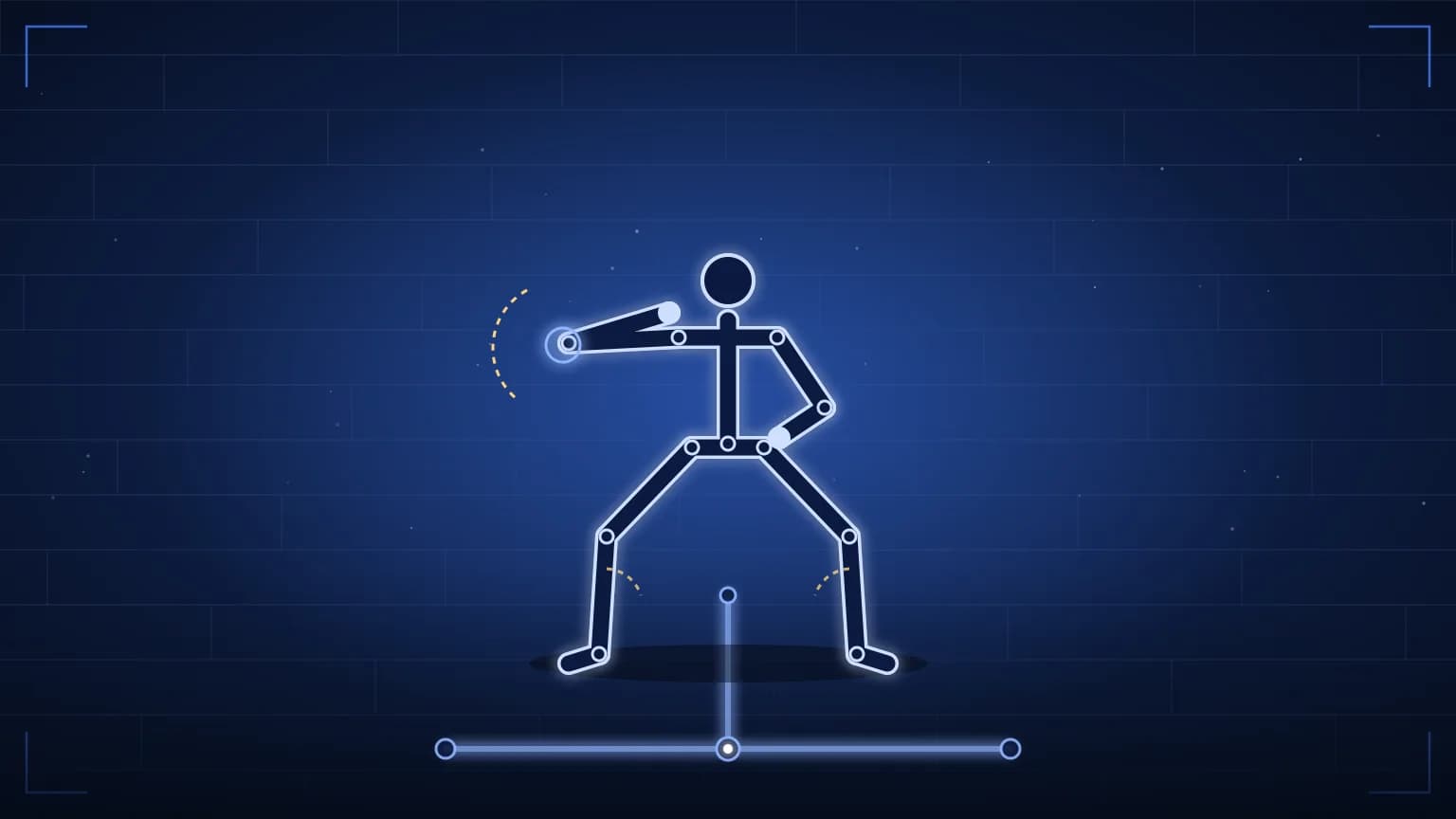
Heian Sandan is the third Heian kata in Shotokan karate, and the Japan Karate Association grades it at 5th kyu. The JKA counts 20 movements: four double blocks with your feet together, a spear hand and a wrist escape, three stamping elbow strikes in kiba-dachi, and a finish of punches over the shoulder with rear elbow strikes, with kiai on moves 10 and 20.
It is the shortest kata of the five Heian forms, and it is the first one where you stamp, swing your elbow and slide both feet at once. Below you get every move with its stance and direction, the floor pattern drawn, what each phrase means in application, and the faults a grader marks.
Check the facts before you start
| What you need to know | Heian Sandan |
|---|---|
| Movements | 20 in the JKA count, 21 in the English Shotokan Karate Association count |
| Kiai | Move 10 (oi-zuki) and move 20 (the last rear elbow) |
| Grade | 5th kyu in the JKA grading guideline, after Heian Nidan at 6th kyu |
| Stances | Kiba-dachi 9 counts, heisoku-dachi 5, kokutsu-dachi 3, zenkutsu-dachi 3 |
| Slow movement | Move 11, both fists drawn to the hips |
| Other names | Pinan Sandan in Shito-ryu and Wado-ryu |
| WKF official kata list | No. 27 as Heian Sandan, no. 72 as Pinan Sandan |
| JKA tournaments | On the designated basic kata (Shitei) list the head judge draws from |
The totals differ because 21-count sheets give the left tate-shuto-uke before the second oi-zuki its own number, while the JKA folds it into move 18. Ask your instructor which count your dojo uses before you count your own runs.
The JKA's Technical Manual for the Instructor lists Heian Sandan at 20 movements and notes that the Heian kata first went by the name Pinan. Quoting Gichin Funakoshi's Karate-do Kyohan, it says mastering the Heian kata gives you proficiency in self-defense and calls them the bridge to the next 15 kata.
Follow the embusen
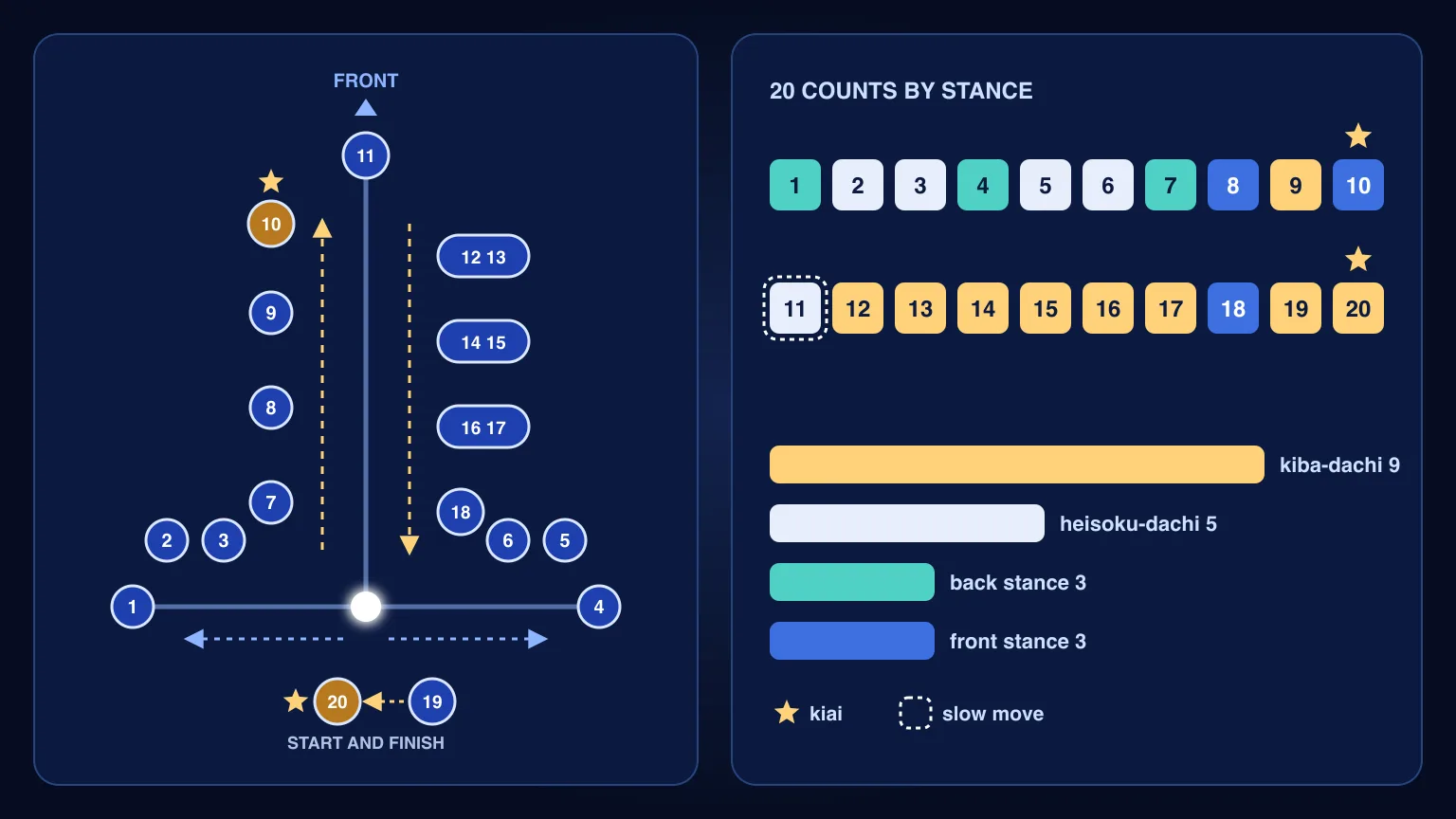
The embusen, the line you travel, looks like an upside-down T. Call the direction you face at the bow "the front."
- Moves 1 to 6 run across the bottom. You block to your left, then to your right, without leaving the bottom line.
- Moves 7 to 10 go up the middle, toward the front, ending in the kiai punch.
- Moves 11 to 18 come back down the same line, with the three stamping steps in kiba-dachi and the punch.
- Moves 19 and 20 finish near your start.
The JKA tournament rules let you finish within one step of your starting spot. Land outside that step and you lose 0.1 to 0.3 points, so mark your start with tape when you practise.
Perform all 20 moves step by step
Start in musubi-dachi, bow, announce "Heian Sandan," and open into yoi in hachiji-dachi with both fists in front of your hips. The counts follow the JKA 20-count sheet used by JKA instructors.
Block left with doubled arms (phrase 1, moves 1 to 3)
- Turn your head left and step your left foot out to the left into kokutsu-dachi, back stance, with your left foot forward. Block with a left chudan uchi-uke, the inside forearm block that sweeps from the inside out.
- Draw your right foot up to your left foot into heisoku-dachi, feet together. At the same moment, block right chudan uchi-uke with your right arm and left gedan-barai with your left arm. Cross your arms in front of your chest first, then let both finish together.
- Stay in heisoku-dachi and switch arms: left chudan uchi-uke and right gedan-barai together.
Repeat it to the right (phrase 2, moves 4 to 6)
- Turn your head right and step your right foot out to the right into back stance with your right foot forward. Block right chudan uchi-uke.
- Draw your left foot up to your right foot into heisoku-dachi. Block left chudan uchi-uke and right gedan-barai together.
- Switch arms in place: right chudan uchi-uke and left gedan-barai together.
Drive up the middle (phrase 3, moves 7 to 10)
- Turn left to face the front and step your left foot forward into back stance. Block morote-uke: a left chudan uchi-uke with your right fist supporting the inside of your left elbow.
- Step your right foot forward into zenkutsu-dachi, front stance. Press your open left hand down (osae-uke) under your right elbow as you thrust a right four-finger spear hand (shihon-nukite) to chest height.
- Turn your right hand over and bring it behind your back as you pivot on your right foot and swing your left foot round 180 degrees into kiba-dachi, horse stance. Strike to the left with a left hammer fist (kentsui) at chest height and pull your right fist to your hip.
- Step your right foot forward into front stance and punch right chudan oi-zuki. Kiai.
Stamp back down the line (phrase 4, moves 11 to 17)
- Turn 180 degrees to your left on your right foot, draw your left foot in to heisoku-dachi, and bring both fists slowly to your hips. This is the only slow move in the kata. Take a full breath through it.
- Turn 90 degrees to your left, raise your right knee and stamp it down to your right (fumikomi) into kiba-dachi, travelling down the line. Swing your right elbow forward at chest height (furi-empi) as the foot lands.
- Snap a right vertical back fist (uraken tate-mawashi-uchi) to head height on the same side, then pull it back.
- Pivot 180 degrees on your right foot, raise your left knee and stamp it down into kiba-dachi, one more step down the line. Swing your left elbow.
- Snap a left back fist to head height.
- Pivot 180 degrees again, raise your right knee and stamp into kiba-dachi. Swing your right elbow.
- Snap a right back fist to head height.
Finish with rear elbows (phrase 5, moves 18 to 20)
- Open your left hand into a vertical knife hand (tate-shuto-uke) toward the bottom of the line, then step your left foot through into front stance and punch left chudan oi-zuki. The JKA counts the knife hand and the punch as one movement.
- Pivot on your left foot and swing your right foot round into kiba-dachi. Punch your right fist up over your left shoulder behind you (tsukiage) as your left elbow drives straight back (ushiro-empi).
- Slide both feet to your right (yori-ashi), keeping kiba-dachi, and mirror it: left fist over your right shoulder, right elbow back. Kiai.
Bring your left foot in, return to yoi in hachiji-dachi, then close to musubi-dachi and bow.
Read the bunkai phrase by phrase
Bunkai means the application of a kata's movements. The JKA manual asks you to show the characteristics and meaning of each movement, and the WKF rules for team bunkai demand that you use the actual movements of the kata. Treat the readings below as common starting points, and test each one slowly with a partner and your instructor before you trust it.
| Moves | What you do | A common reading |
|---|---|---|
| 2, 3, 5, 6 | One arm blocks middle while the other sweeps low | Cover a middle punch and a low attack at once, or trap an arm between your forearms and twist it |
| 7, 8 | Reinforced block, then press down and spear hand | Clear the attacking arm, press it down and counter into the solar plexus |
| 9 | Hand turned behind your back as you spin | Escape a wrist grab by turning into it, then hit with the hammer fist on the way round |
| 10 | Step and punch | Finish the escape with a full-body counter |
| 12 to 17 | Knee lift, stamp, elbow, back fist | Stamp the attacker's knee or instep, drive the elbow into the body, whip the back fist to the face |
| 18 | Knife hand, then punch | Catch or cover the attacking arm, then counter on the same line |
| 19, 20 | Punch over the shoulder with a rear elbow | Answer a grab from behind: elbow to the ribs, fist to the face |
Move 9 is the one most instructors teach first. Have a partner grip your right wrist after the spear hand, turn your palm down, and feel how the turn of your whole body breaks the grip with almost no arm strength.
Fix the faults graders mark
The JKA manual lists what examiners check: flat soles with heels down, hips level, simultaneous hands and feet, proper aim, a clear change of speed, and a return to the starting point. Here is where each one breaks down in Heian Sandan.
| Where | The fault | The fix |
|---|---|---|
| Moves 1, 4, 7 | Weight drifts onto the front foot in back stance | Keep about two-thirds of your weight on the back leg and sit the hips low |
| Moves 2, 3, 5, 6 | The two arms finish at different moments | Cross the arms first, then finish both blocks on one beat with one breath |
| Move 8 | The spear hand aims at the face | Aim at the solar plexus, with the left hand flat under the right elbow |
| Move 9 | You hop round and leave the line | Pivot on the right foot and place the left foot straight down the line |
| Move 11 | You rush the slow move | Count three seconds and breathe in; the JKA rules score change in speed |
| Moves 12 to 17 | Knees cave in during kiba-dachi | Push both knees out over your toes and keep your heels flat |
| Moves 12 to 17 | The elbow and the stamp land at different times | Land the foot and the elbow on the same beat |
| Moves 19, 20 | You finish more than a step from your start | Shorten or lengthen the three stamps until you land on your tape |
| Moves 10, 20 | No kiai, or a kiai in the wrong place | Kiai only on the oi-zuki and the last rear elbow |
Count your movements aloud once a week. The JKA manual tells you to "verify that there is an accurate number of movements", and its tournament rules deduct for a movement done in the wrong order.
Build a three-week practice plan
A Heian kata is short and hard. In a 2012 study, Bussweiler and Hartmann measured Shotokan karateka performing Heian Nidan, a kata of about 30 seconds: 52 percent of the energy came from the anaerobic alactic system, the one that fuels short sprints, and blood lactate rose as high as 8.1 mmol/L. Treat each full-speed run as a sprint and rest about a minute between runs. That rest is a sensible default, so adjust it with your coach.
- Week 1. Learn phrases 1 and 2. Run moves 1 to 6 five times a session, slowly, checking that both arms finish together on every double block.
- Week 2. Add phrases 3 and 4. Drill move 9 with a partner holding your wrist, then run moves 1 to 17 three times.
- Week 3. Add phrase 5 and run the full kata four times a session at full speed with a minute of rest. Check your finishing spot against the tape every time.
Kiba-dachi and fumikomi load your knees. Stamp with control on a hard floor, stop if your knee hurts, and see a physician or physiotherapist about pain that lasts after training. If you came straight from the first Heian kata, review its count map in the Heian Shodan step-by-step guide, and drill your back stance and horse stance with the karate stance guide before you add speed.
Film one run and check it frame by frame
You cannot see your own knees in kiba-dachi while you stamp. Film one full run from the front, at hip height, with your whole body and both ends of the line in frame. A 2026 pilot study in Scientific Reports built a phone app that measured joint angles in zenkutsu-dachi, kokutsu-dachi and kiba-dachi, the three main stances of this kata, though its authors warn that a single-participant pilot only shows the idea works.
Watch the clip at half speed and check three things: do both arms finish together on moves 2, 3, 5 and 6, do your knees stay out on moves 12 to 17, and do you land back on your tape after move 20. Write the one fault you see beside the matching count, and work on that one in your next session. For the wider picture of judging, read our guide on how to improve kata performance.
Plan your next grading
Heian Sandan is your kata for 5th kyu in the JKA syllabus, alongside moving kihon and kihon ippon kumite. Heian Yondan follows at 4th kyu. See every grade's kata in our Shotokan kata list and prepare the rest of the test with the belt test preparation guide.
If you train Shito-ryu or Wado-ryu, you know this kata as Pinan Sandan. Open it in the karate kata finder to see both names and their WKF list numbers side by side. The WKF rules allow slight variation as taught by your style, so a Pinan Sandan from another dojo can differ in detail from the 20 counts above. Later, at 1st kyu, you will learn Bassai Dai, the first long kata of the syllabus.
Get quick answers about Heian Sandan
How many moves are in Heian Sandan?
Heian Sandan has 20 movements in the JKA count. The English Shotokan Karate Association counts 21. Sheets with 21 counts give the knife hand before the second oi-zuki its own number.
What belt is Heian Sandan for?
The JKA grading guideline sets Heian Sandan for 5th kyu. Belt colours for that grade differ between dojo, so check your own syllabus.
What does Heian Sandan mean?
The English Shotokan Karate Association translates it as "Peaceful Mind, Level 3." The Japan Karatedo Federation dictionary says Anko Itosu created the Pinan kata in the Meiji era, and the JKA manual notes that Shotokan's Heian kata first went by the name Pinan.
Where are the kiai in Heian Sandan?
You kiai on move 10, the right oi-zuki at the top of the line, and on move 20, the last punch over the shoulder with the rear elbow.
What comes after Heian Sandan?
Heian Yondan, the JKA's kata for 4th kyu. It adds front kicks, side kicks and a knee strike to the stances you used here.
Check the sources
- Japan Karate Association, Technical Manual for the Instructor
- Japan Karate Association, kyu and dan grading guideline
- Japan Karate Association, Tournament Rules and Regulations, April 2025, Items 34, 36 and 37
- World Karate Federation, Kata Competition Rules 2026, Articles 5.3.2 and 5.6 and Appendix 1
- Japan Karatedo Federation dictionary, Pinan (Heian)
- Japan Karatedo Federation dictionary, Shito-ryu
- Japan Karatedo Federation, favorite kata lists by style, 2013 rule change
- English Shotokan Karate Association, kata list
- Bussweiler J, Hartmann U. Energetics of basic karate kata. Eur J Appl Physiol. 2012;112(12):3991-6
- Silva CM, Pataca AO, Branco F, Coelho PJ, Pires IM. A pilot study of a mobile application for postural analysis and training support in Shotokan Karate. Sci Rep. 2026;16:11129