
Training
Kumite Distance and Timing Drills
Improve kumite distance and timing with progressive partner drills that keep the target, intensity, rules and safety constraints clear.
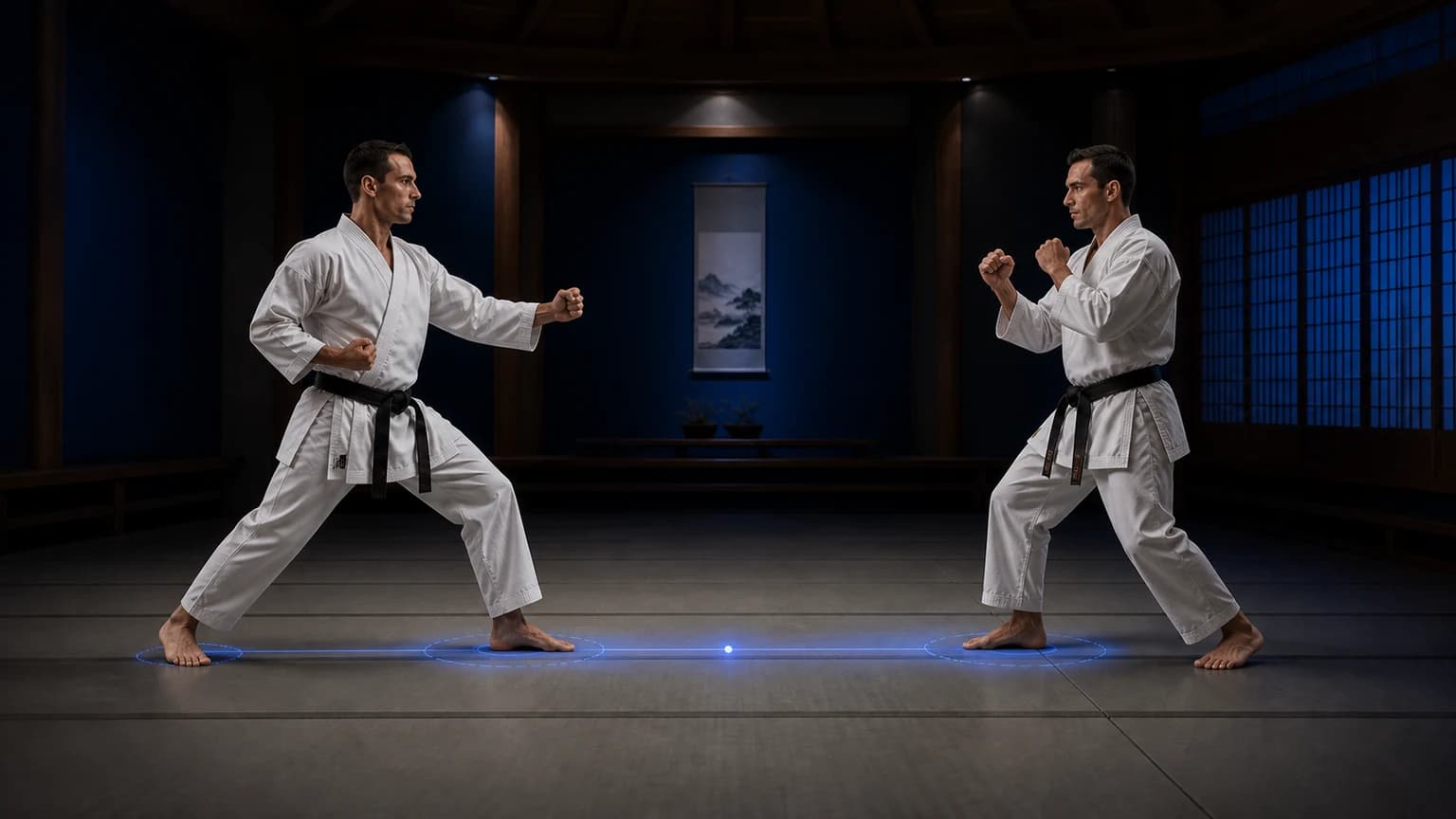
Improve kumite distance and timing by progressing from a fixed target to a cooperative moving partner, then to a constrained decision drill. Keep the technique and intensity controlled. Change only one variable at a time so you can tell whether you read the distance, chose the moment or simply moved faster.
Define the distance before you attack
Start outside your effective range. Move into a balanced position from which your chosen technique can reach without leaning, hopping after the strike or colliding with your partner. Your useful distance changes with the technique, stance, partner, rule set and tactical goal, so a fixed number of centimetres cannot settle it.
Use a removable floor marker to record your start point. Test the range slowly with a pad or a cooperative partner. Finish in control, recover your guard and return to the same mark. If you cannot stop the technique or keep your base, increase the distance and reduce the speed.
Drill 1: one-step range calibration
Choose one scoring technique that your instructor approves. Your partner holds a safe target and stays still. Begin beyond range, enter once, place the controlled technique and leave. Complete three careful repetitions, then move the start marker by a small amount and repeat.
Ask one question: where can you reach without stretching your head past your base? Use the same stance and target each time. This drill builds a reference, not a universal “correct” distance.
Drill 2: partner-led distance changes
Your partner moves forward or backward at walking pace while you maintain the agreed gap. Do not attack during the first round. Keep your feet underneath you and match the change without crossing your legs or bouncing into range by accident.
In the second round, your partner pauses briefly. Enter only on the pause, then reset. The pause makes the timing readable while the moving start prevents you from memorising one floor mark.
Drill 3: cue, enter, recover
Agree on one visual cue, such as your partner opening a glove or touching a pad. Start at calibrated range. When you see the cue, enter with the agreed technique and recover to a safe position. Your partner controls the cue; you control the technique.
Do not guess. If you move before the cue, count it as an early decision rather than a successful fast repetition. If you see the cue but cannot reach without losing balance, reset the distance before you raise the pace.
Drill 4: two-choice timing
Give your partner two clear actions. For example, they can pause or take one step back. Attack only on the pause; maintain distance on the step. This forces you to read before you commit. Keep the choices large and predictable at first, then reduce the warning only after both athletes stay controlled.
The goal is not to trick your partner. The goal is to connect a visible event to the right response. Add a third choice only when you can explain why each option calls for a different action.
Drill 5: constrained kumite round
Run a short, light round with one permitted entry and one permitted counter. Mark a safe boundary and agree on contact level, protective equipment, stop signal and reset condition. One partner initiates; the other manages distance and chooses whether the valid moment appeared.
After the round, each person names one observation: “I entered while your weight was still moving back” or “I followed your hands and missed the step.” Avoid declaring motives. Video and observation can show movement; they cannot prove what your partner intended.
Review what happened first
Film one round from the side with both athletes fully visible. Watch it once at normal speed. Then label the first event in each exchange: distance closed, cue appeared, decision began, technique extended, control ended. This order helps you separate a range error from a late read.
Use the setup in our karate video-analysis guide so the camera does not distort the starting gap. If your base changes during entry, revisit the karate stance guide. Kata athletes can also use the one-variable method in our kata performance guide.
Safety and rules
Practise partner drills under a qualified instructor who sets the contact level and matches partners appropriately. Stop immediately when either person calls stop or when control breaks down. Do not continue through pain, dizziness or symptoms after head contact; seek appropriate professional care. Follow your dojo's policy and the rules for your event. The World Karate Federation rules and statutes provide a public starting point, but your event officials decide how the current rules apply.
A simple four-week progression
In week one, calibrate range and recover under control. In week two, add cooperative movement. In week three, add one visual cue and one decision. In week four, test the skill in short constrained rounds. Keep one baseline clip and one note from each week. If control drops, return to the prior step instead of forcing the schedule.
Method and sources
We built these drills from first-principles coaching constraints, current public WKF rules and a live review of pages and videos that rank for kumite distance-and-timing searches on 15 August 2026. We did not invent a universal range, scoring guarantee or injury-prevention claim. Your instructor, event rules and training partner set the conditions for live practice.