Technique
Throw a Better Mae Geri: Front Kick Steps, Drills and Fixes
Learn mae geri, karate's front kick, with the four-phase mechanics, keage versus kekomi, common faults with fixes, and five drills for a faster chamber.
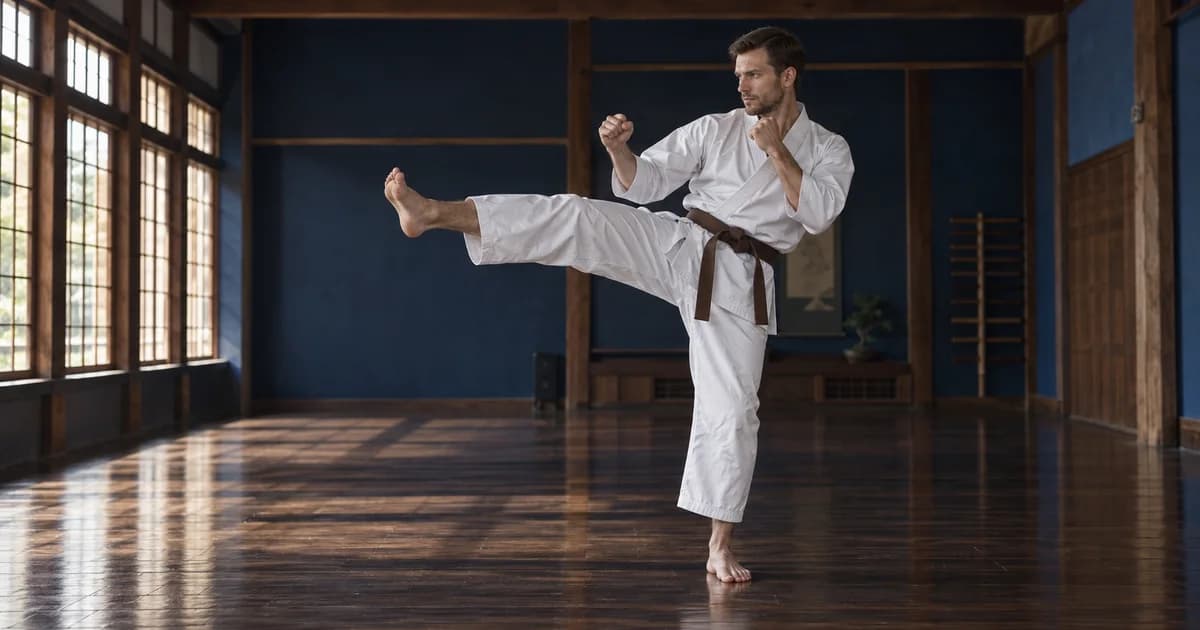
Mae geri, the front kick, works in four parts: lift your knee straight toward the target, snap or drive the ball of your foot out, pull it back to the chamber as fast as you sent it, and set it down in a balanced stance. It is the first kick almost every karateka learns, because every other kick in the system reuses the same chamber-extend-retract pattern. Get mae geri right and you fix your mawashi geri, your yoko geri and your kumite footwork at the same time.
This guide breaks mae geri into its four phases, separates the two ways you can throw it, lists the faults that cost beginners the most speed and power, and gives you five drills to clean it up.
Break mae geri into 4 phases
- Chamber. Drive your knee straight up in front of your body, pointing it at the target. Pull your toes back so the ball of your foot is ready to strike, and keep your standing leg slightly bent.
- Extend. Snap or thrust your lower leg out from the knee. Your hip drives forward and slightly up as the leg straightens, so the kick lands with your whole bodyweight behind it.
- Retract. Pull the foot back to the chamber position at the same speed you sent it out. A kick that hangs in the air after impact is a kick an opponent can catch or counter.
- Land. Step down under control, inside your stance, with your guard already back up. Where you place your foot decides whether you can kick again or need to reset.
Your supporting leg does more work than people expect. Keep a soft bend in the knee, turn the heel slightly toward the target as your hip rotates, and keep your arms up for the whole kick.
Choose between mae geri keage and kekomi
Mae geri splits into two expressions depending on whether you want speed or penetration.
| Version | Foot path | Power source | Typical use |
|---|---|---|---|
| Mae geri keage (snap) | Knee chambers high, lower leg snaps out and back like a whip | Fast knee extension | Scoring kicks at kumite range, feints |
| Mae geri kekomi (thrust) | Knee chambers, hips drive the whole leg through the target | Hip drive and follow-through | Breaking balance, striking through a pad or body shield |
Train both from the same chamber. Beginners usually default to keage because it looks like the kicks they see in kata, so make kekomi a deliberate, separate rep rather than something you only discover by accident.
Where mae geri fits in kumite
Mae geri is a mid-range tool. It keeps a charging opponent at a distance, it scores before they can close to punching range, and it sets up combinations because your kicking leg lands back in a stance ready to step through with a reverse punch.
In World Karate Federation kumite, scoring depends on the target: a mae geri to the chudan area (stomach) scores waza-ari, worth 2 points, and a mae geri to the jodan area (head, face, neck) scores ippon, worth 3 points, the same scale that applies to every scoring kick in the sport. Judges still look for good form, correct distance, proper timing and sporting attitude, beyond contact alone. Our karate tournament scoring guide breaks down every criterion a referee checks, and the kumite distance and timing drills article gives you partner drills to find that scoring range on purpose instead of by accident.
Fix the common mae geri mistakes
| Mistake | Why it happens | Fix |
|---|---|---|
| Telegraphing the kick | You drop your hands or lean back before lifting the knee | Keep your guard still and chamber the knee as the first visible movement |
| Kicking from a low chamber | You extend before the knee reaches full height | Pause at the top of the chamber in slow reps until the habit sticks |
| Slow retraction | You treat the kick as finished once it lands | Count the retraction out loud: as fast back as out |
| Leaning back on extension | You try to add reach by tilting your upper body away from the target | Keep your spine stacked over your hips and let your hip drive provide the reach |
| Landing off balance | You rush the final step instead of placing it | Land every practice kick in a stance you could immediately kick again from |
How mae geri changes as you progress
Your instructor will expect more from the same four phases as you move up in grade. Use this as a rough map of what "better" looks like at each stage.
| Level | What you focus on | What a coach checks |
|---|---|---|
| New student | Chamber height, balance on one leg, landing without stumbling | Does the knee lift before the leg extends at all |
| Intermediate | Speed of extension and retraction, kicking without telegraphing | Does the guard stay up and the hips stay level through the kick |
| Advanced | Kicking off either leg equally, mae geri inside combinations, distance management in kumite | Does the kick still look the same under pressure, tired, or off the back foot |
Jumping straight to advanced goals, like chaining mae geri into a spinning technique, before your chamber and retraction are automatic just bakes the fault into a faster, harder-to-fix version of itself.
Sharpen your mae geri in 5 drills
- Slow-count kicks. Chamber, extend, retract and land over four slow counts, ten reps per leg. This exposes a sloppy chamber immediately because there is nowhere to hide it.
- Wall or chair chamber. Hold a wall or chair for balance and drill the chamber and knee lift on its own, without worrying about the kick itself.
- Pad penetration. Hold or have a partner hold a kick shield, and drive ten mae geri kekomi through the pad, aiming your hip to drive past the surface rather than stop at it.
- Snap counter. Hang a light target (a pad, a sock with a ball inside) and throw mae geri keage at it, focused purely on retraction speed after contact.
- Step-through combination. Mae geri, land, and immediately step through with a reverse punch. This trains the kick as part of a sequence instead of an isolated drill, which is closer to how it works in karate kicks combinations and in sparring.
Stretch your hips and hamstrings after training. Do not kick at full height on cold muscles. Height and speed come from a strong chamber and hip rotation built up over weeks, and forcing a deep stretch into a cold kick just invites injury.
If the Japanese terms slow you down mid-drill, that is normal. Run keage, kekomi, chudan and jodan through the karate terminology trainer until you can hear your instructor call them without translating in your head first.
Common questions
What does mae geri mean?
Mae geri means "front kick" in Japanese. Mae means front and geri (from keri) means kick, and the name simply describes the direction of the strike.
Is mae geri a snap kick or a thrust kick?
Both. Mae geri keage is the snapping version, used for speed and scoring kicks. Mae geri kekomi is the thrusting version, used to drive through a target or break an opponent's balance. Most karateka train both from the same chamber.
Why does my mae geri feel weak?
Weak mae geri almost always comes from kicking with the leg alone. Drive your hip forward and slightly up as the leg extends, and keep your standing leg's knee soft so your hip can rotate freely.
How high should a beginner's mae geri go?
High enough to hit the chudan (stomach) target with a full chamber and controlled retraction. Chase height only after your chamber, extension and retraction are clean at a lower target, since poor mechanics at height just teach bad habits faster.