Guides
What Is Wado-Ryu Karate? Origins, Stances and How It Differs
Learn what makes Wado-Ryu karate different: its jujutsu-influenced origin, tai sabaki body shifting, stance height and how its kata compare to Shotokan.
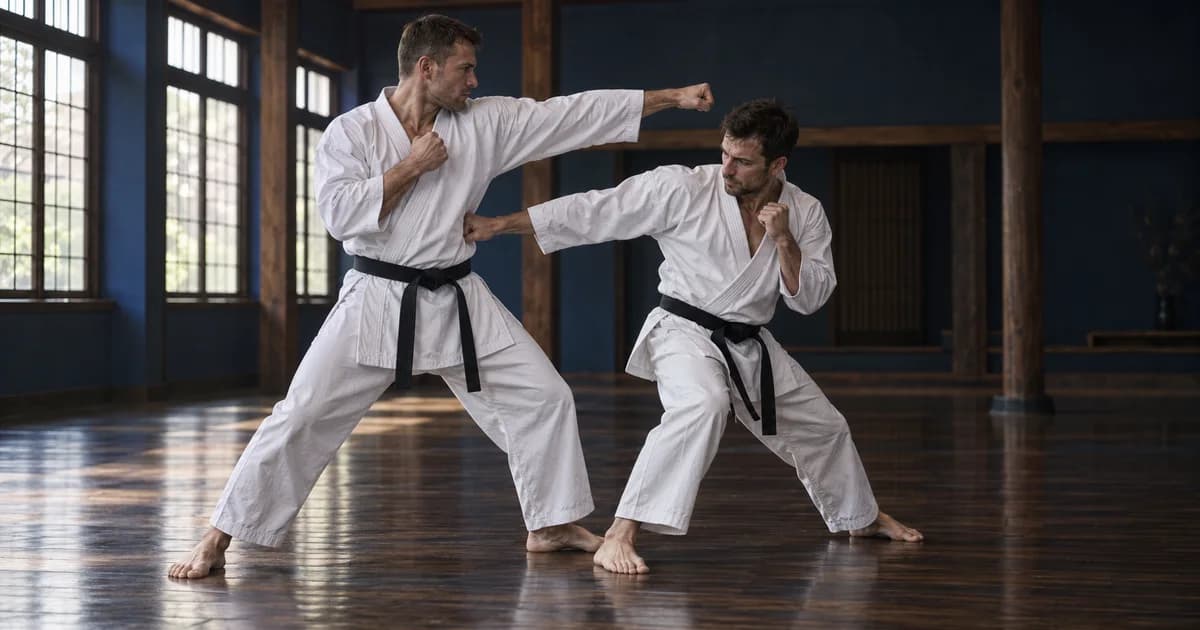
Wado-ryu is one of the four major traditional styles of Japanese karate, built around tai sabaki, body shifting that moves you off an attack's line instead of blocking it head-on. Hironori Otsuka founded it in the 1930s by blending the karate he learned under Gichin Funakoshi with Shindo Yoshin-ryu jujutsu he had trained in since childhood, which is why Wado-ryu looks lighter and more evasive than the style it grew out of. The rest of this guide covers where that difference comes from, how Wado-ryu stances and kata compare to Shotokan, Goju-ryu and Kyokushin, and what to expect walking into your first class.
Where Wado-ryu comes from
Otsuka trained in jujutsu from childhood and became one of Funakoshi's earliest students, eventually serving as his chief assistant instructor. Rather than teach Funakoshi's karate unchanged, Otsuka folded in the joint locks, throws and body-shifting principles of his jujutsu background, registering his own style under the name Wado-ryu, "the way of harmony." The result keeps karate's striking core but adds jujutsu's instinct for moving around an attack rather than meeting it with a hard block.
Otsuka died in 1982, and like several traditional styles that outlive their founder, Wado-ryu split into more than one organization afterward. That history is why you will meet schools that all call themselves Wado-ryu but run slightly different kata lists or grading syllabi. None of them is the single "correct" version; ask your own instructor which lineage and syllabus your dojo follows.
That history is also why Wado-ryu sits inside the same family as Shotokan rather than outside it. Both trace back to Funakoshi, so you will recognize plenty of shared vocabulary and several shared kata between the two styles, even though the way Wado-ryu moves through them looks different.
Why Wado-ryu emphasizes tai sabaki
Tai sabaki means body shifting: turning your hips, stepping off the centerline, or angling your whole body so an incoming strike meets space instead of your torso. Where a harder style trains you to block force with force, Wado-ryu trains you to not be where the force is aimed in the first place, then counter from the new angle you just created.
In practice this shows up as:
- Shorter, higher stances than Shotokan's long, low zenkutsu-dachi, because Wado-ryu prioritizes mobility and quick direction changes over a deep, rooted platform.
- Minimal blocking force. A Wado-ryu block often redirects or deflects an attack rather than stopping it dead, which takes less raw strength and more timing.
- Hip rotation that doubles as evasion. The same hip turn that generates power for a counter punch is often the movement that got you off the original attack's line.
Try the idea against a simple, controlled jab with a partner: as the punch comes in, step 45 degrees off the centerline instead of straight back, let your lead hand brush the punch past you rather than block it hard, and throw your own counter from the new angle you just created. You are not trying to out-muscle the punch. You are trying to not be where it lands.
Compare Wado-ryu with other major styles
| Style | Core emphasis | Typical stance | Contact in training |
|---|---|---|---|
| Wado-ryu | Tai sabaki, evasion, flowing counters | Shorter, higher, mobile | Light to medium |
| Shotokan | Linear power, deep stances, strong blocks | Long and low | Medium, controlled |
| Goju-ryu | Close-range circular technique, breathing | Natural, rooted | Medium |
| Kyokushin | Full-contact conditioning and power | Wide and grounded | Full contact (no gloves on the body) |
No row in that table is "better." Each style optimizes for a different answer to the same problem: what do you do when someone attacks you. If you want to compare two of these styles in more depth, Shotokan karate for beginners, Goju-ryu and Kyokushin karate each cover their own style the same way this guide covers Wado-ryu.
What you will practice in a Wado-ryu class
A typical class still follows karate's standard three-part structure: kihon (basics), kata (forms) and kumite (sparring). What changes inside that structure is emphasis.
- Kihon with footwork. Basic punches and blocks are drilled together with the step or pivot that gets you off the line, built in from day one.
- Kata that carries Wado-ryu's own lineage. Pinan/Heian forms appear, as in most Japanese styles, alongside Wado-ryu-specific kata such as Seishan, Chinto and Wanshu, which keep the tighter, more mobile stance work throughout.
- Kumite built on distance and timing. Because the style leans on evasion, sparring drills spend real time on reading an opponent's timing and closing the gap after you have moved off their line, beyond simply trading points at a fixed range.
- Ju no kata-adjacent partner work. Some Wado-ryu lines keep light joint-control and throwing drills close to the surface, a visible trace of Otsuka's jujutsu background that other styles dropped.
Learn the Wado-ryu kata and why they are named Pinan
Otsuka recognized nine kata as Wado-ryu's official core: five Pinan kata (Pinan Shodan through Pinan Godan), plus Kushanku, Naihanchi, Seishan and Chinto. Most schools today add several more from the wider Okinawan canon, commonly Passai, Wanshu, Rohai, Niseishi, Jitte and Jion, though which of those a given dojo teaches depends on its specific organization.
Here is the detail that trips up anyone who trains in more than one style: when Funakoshi systematized Shotokan, he renamed the same Okinawan Pinan series, created by Anko Itosu, to Heian. Otsuka kept the older name, Pinan, when he founded Wado-ryu. So a Wado-ryu Pinan Nidan and a Shotokan Heian Nidan share the same root and a similar sequence, but you will hear two different names depending on which dojo you are in. Shotokan's own Heian Shodan step by step guide is a useful side-by-side if you already know that version.
| Kata group | Example kata | What it builds |
|---|---|---|
| Pinan series (5 kata) | Pinan Shodan to Pinan Godan | Stances, basic blocks and strikes in combination |
| Core advanced kata | Kushanku, Naihanchi, Seishan, Chinto | Tai sabaki applied inside a full form, directional changes |
| Extended kata (school-dependent) | Passai, Wanshu, Rohai, Niseishi, Jitte, Jion | Weapon-defense concepts, jumping, longer sequences |
Avoid these mistakes when you start Wado-ryu
- Copying Shotokan depth. If you arrive with experience in a harder style, resist dropping into a long, low stance out of habit. Wado-ryu's higher stance is a deliberate choice.
- Blocking instead of shifting. Beginners often meet a strike head-on because it feels safer. Trust the footwork drills: moving your body is the block.
- Skipping belt and kata order. Wado-ryu still runs on the same kyu-to-dan grading structure as other Japanese styles, so confirm with your instructor which kata your dojo expects at each grade before you practice ahead of your level.
- Treating tai sabaki as footwork alone. The shift has to connect to a counter. Practice the step and the strike as one connected motion.
Common questions
Is Wado-ryu a hard style or a soft style?
Wado-ryu sits between the two. It keeps karate's striking core from Shotokan but adds the softer, redirecting movement of Shindo Yoshin-ryu jujutsu, so it trains less raw blocking force than a hard style and more evasive body shifting.
Is Wado-ryu good for self-defense?
Its emphasis on moving off an attacker's line, closing distance after you shift, and the light joint-control work some schools retain from its jujutsu roots all transfer directly to self-defense situations, though any style trained consistently with realistic drills builds useful defensive skill.
How is Wado-ryu different from Shotokan?
Wado-ryu uses shorter, higher stances and tai sabaki, body shifting, to evade an attack before countering. Shotokan trains longer, lower stances and favors meeting an attack with a strong, committed block. Both share a common lineage through Gichin Funakoshi.
Does Wado-ryu compete in WKF tournaments?
Yes. Wado-ryu is one of the four major Japanese styles whose kata appear on the official World Karate Federation kata list, and Wado-ryu practitioners compete in both kata and kumite under standard WKF rules.