Training
How to Practise Karate at Home Between Dojo Sessions
Learn karate at home between dojo sessions with safe kihon, kata, footwork, video review, clear decisions, and coach-led corrections.
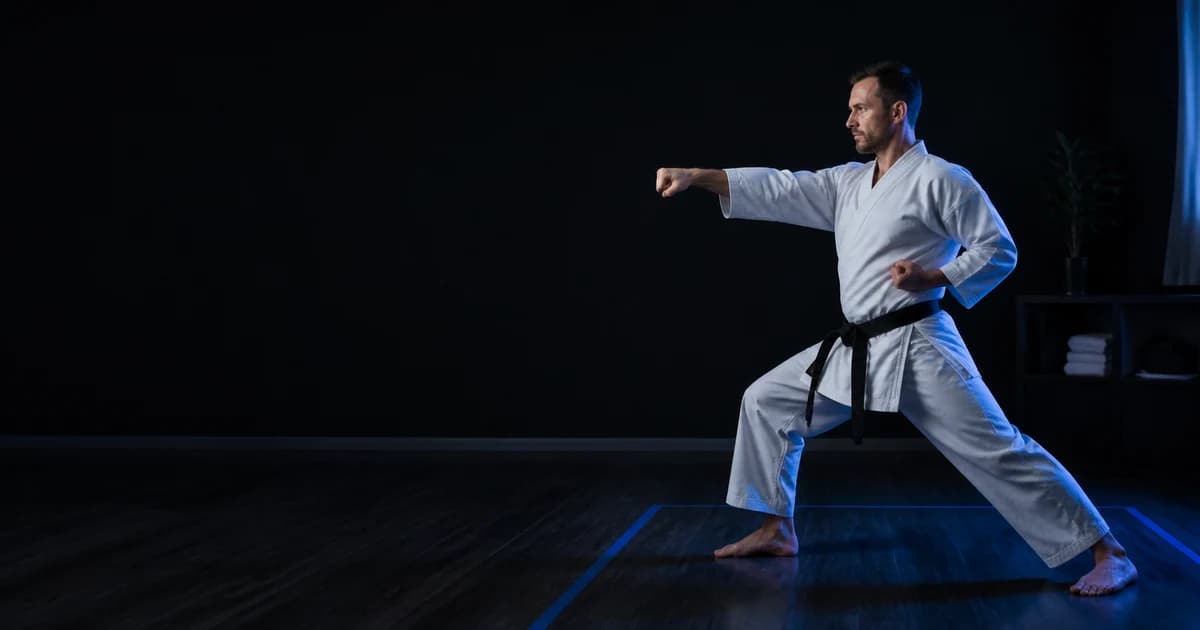
You can practise karate at home by repeating kihon, kata sections, stance transitions, and non-contact footwork that your instructor has already taught. Use each session to observe one visible detail, decide whether it needs attention, and revise it through slow, controlled repetitions. Home practice cannot replace partner resistance, supervised contact, live coaching, belt-test decisions, or competition judgment.
Decide what belongs in home practice
Start with material you already recognise from instructor-led training. Your instructor should define your syllabus, technical model, and current priorities. If you cannot name a movement, explain its purpose, or recall how your instructor taught it, write it down as a question instead of improvising an answer.
Suitable solo work may include:
- Moving between familiar stances
- Performing a known punch, block, or kick below your safe range
- Rehearsing short kata sections
- Practising guard recovery and controlled footwork
- Reviewing the order and direction of a known sequence
- Completing familiar conditioning exercises with sound form
- Recording questions for your next class
Do not practise contact sparring, throws, takedowns, joint manipulation, weapon work, or improvised impact drills alone. A hanging bag, wall, chair, or family member does not become a safe substitute for qualified supervision.
If you need to review basic positions first, use the karate stance guide and the separate guide to common karate blocks. Treat those pages as references, then follow the version taught in your dojo.
Prepare a safe training area
Clear the full path of every step, turn, and kick before you begin. Check the space at floor level as well as shoulder and head height.
Remove:
- Rugs that slide or curl
- Furniture with sharp corners
- Lamps, glass, and low shelves
- Pets, toys, cables, and loose equipment
- Hanging objects that could catch a raised hand
- Anything behind you that you cannot see during a turn
Use a dry, level surface with enough grip for controlled movement. Socks can slide on smooth flooring. A surface with excessive grip can also catch the foot during a pivot. Test one slow stance transition before increasing speed.
Keep kicks within a height and range you can control without leaning, snapping the joint into a hard lock, or striking nearby objects. Stop if you feel pain, dizziness, unusual weakness, or loss of balance that does not settle normally. A recording cannot diagnose the cause. Seek appropriate guidance from a qualified coach or healthcare professional when needed.
Build a short session around one question
A useful home session does not need dozens of techniques. Choose one question that you can investigate through visible evidence.
Examples include:
- Does my front knee track in the same direction as my toes?
- Do both feet finish before I deliver the next technique?
- Does my head rise during the stance transition?
- Do I recover my guard after gyaku-zuki?
- Does each kata turn finish on the intended line?
- Can I repeat the same movement without rushing the preparation?
Use this compact structure:
| Block | Time | Task | Decision |
|---|---|---|---|
| Preparation | 3 to 5 minutes | Clear the space and rehearse the movement gently | Continue only if the area and movement feel controlled |
| Observation | 3 minutes | Record two or three normal repetitions | Select one visible difference |
| Revision | 5 to 10 minutes | Repeat slowly with one cue | Keep, adjust, or stop the cue |
| Confirmation | 2 minutes | Record the same view again | Compare the same checkpoint |
| Training note | 1 minute | Write the evidence and one question | Take unresolved points to your instructor |
The times are examples, not performance targets. Fatigue, experience, available space, and your instructor’s plan should determine the actual workload.
Use the observe, decide, revise method
1. Observe one visible checkpoint
Watch the recording once at normal speed. Identify what the camera actually shows.
Visible evidence can include:
- Foot placement inside the frame
- Knee direction from a suitable angle
- Changes in head height
- Guard position
- Sequence order
- Turn direction
- Whether the whole foot remains visible
- The timing between a step and a technique
- Whether posture changes across repeated attempts
The video cannot establish everything. It cannot reliably tell you:
- How much tension you felt
- What you intended to do
- Whether an unseen surface affected your footing
- How much resistance a partner supplied
- Whether pain came from a particular structure
- What happened outside the frame
- Whether fatigue, fear, distraction, or prior injury caused a change
- Whether an examiner would accept the movement
Separate observations from interpretations. “My heel left the floor before the turn” describes visible evidence. “My hip mobility is bad” makes a broader claim that the clip cannot prove.
2. Make one decision
Choose the smallest decision supported by the recording.
| Observation | Sensible decision | Decision to avoid |
|---|---|---|
| The rear foot leaves the frame | Move the camera or widen the view | Assume the foot position was wrong |
| The head rises during three transitions | Repeat slowly while keeping a consistent level | Add speed to force a stronger stance |
| The guard drops after each punch | Rehearse the return path at low speed | Diagnose fatigue or shoulder weakness |
| Two kata turns finish on different lines | Mark a safe reference point and compare again | Declare one version correct without instructor input |
| Form changes late in the set | Reduce the set and record a fresh repetition | Treat the final repetition as a technical baseline |
| Pain appears during a movement | Stop that movement and seek appropriate guidance | Use the video to identify an injury |
A decision should change the next repetition. “Improve my technique” is too broad. “Finish the stance before extending the punch” gives you a testable action.
3. Revise under easier conditions
Reduce speed, range, or sequence length. Keep the same camera angle and repeat the same checkpoint.
Change only one variable at a time. If you alter stance length, tempo, guard position, and camera placement together, you will not know which change affected the result.
After three to five controlled attempts, record another short set. Compare it with the first recording. If the visible issue remains, note it for your instructor instead of adding more corrections from guesswork.
Worked example: revising gyaku-zuki from zenkutsu-dachi
Suppose you want to review a reverse punch your instructor has already taught.
Place the camera where it can show your entire body, both feet, and enough floor to see the stance. Perform three repetitions at a normal home-practice pace. Do not strike a wall, furniture, or another person.
On review, you notice that your head rises before two punches. You cannot conclude that the stance is too long, your legs are weak, or your timing is incorrect. The clip only shows a repeated change in height.
Your decision is: “Repeat the transition slowly and keep my head level until the front foot settles.”
Perform four slow repetitions with that single cue. Then record three more from the same position. Compare:
- The frame just before movement begins
- The moment the front foot arrives
- The final punch position
- The recovery to guard
If the second set shows a smaller rise without creating a forced posture, record the cue in your training note. If the movement becomes uncomfortable, unstable, or inconsistent, stop revising it and ask your instructor to check the transition.
For more detail on the technique itself, read the gyaku-zuki technique guide. Keep your dojo’s instruction as the controlling reference.
Practise kata in sections
A full kata can hide the cause of an error because one missed position affects everything that follows. Divide the kata into short, named sections that preserve the actual sequence.
A section might contain:
- The starting position
- One turn
- One stance transition
- One or two techniques
- A controlled finish and reset
First, rehearse the sequence without chasing speed or dramatic power. Check direction, order, posture, foot placement, and the point at which each turn finishes. Then connect two sections only when each remains repeatable.
Avoid using a camera angle to judge qualities it cannot show. A front view may reveal lateral drift but obscure stance length. A side view may show posture and front-to-back movement but hide changes in width. Use the kata performance guide to structure a deeper review.
Competition and grading standards depend on the relevant rules, event, organisation, and examiner. The World Karate Federation publishes its current statutes and rules online, but those documents do not replace instructions from your dojo or the requirements of your specific event.
Review footwork without pretending there is an opponent
Solo kumite practice can develop repeatable movement patterns, but it cannot reproduce an opponent’s timing, pressure, reactions, reach, or resistance.
Choose a simple non-contact task:
- Begin in your familiar guard.
- Move forward or backward once.
- Stop under control.
- Perform a known technique into open space.
- Recover your guard and position.
- Reset before the next repetition.
On video, check whether your feet cross, your stance narrows unexpectedly, your guard changes during movement, or your balance continues after the intended stop. Do not infer effective distance from an empty room. Distance only becomes meaningful in relation to a target or partner, and partner work belongs under appropriate supervision.
The kumite distance and timing drills guide explains how to separate movement mechanics from decisions that require a partner.
Film clips that you can compare
Place the phone on a stable support. Do not balance it where it can fall into your training area. Use a clear, uncluttered view with the lens approximately level rather than sharply tilted.
For most technique reviews:
- Keep your whole body and both feet in frame
- Include the floor around your stance
- Leave room in the direction of travel
- Use steady lighting
- Avoid loose clothing that hides joint positions
- Record a few repetitions, not one long exhausted set
- Keep the same angle for before-and-after comparison
- Save normal-speed footage even if you also inspect slow playback
Choose the angle based on the question. Use a side view for changes in height, front-to-back stance length, and trunk position. Use a front or rear view for stance width, lateral drift, and some knee-to-foot relationships. Use a diagonal view when you need general context, but recognise that perspective can distort alignment.
Follow the karate video-analysis methodology when separating what the clip shows from what you think caused it. The longer video-analysis guide provides a repeatable review sequence.
Use one recorded clip to plan the next action
After you have established a clear question and recorded comparable repetitions, you can open Karate AI: Dojo Coach and submit one recorded kata, kumite, or kihon clip for technique feedback. Choose one point from that review, record it in the training log, and take the resulting question to your next instructor-led session. The app also includes structured karate plans with coached session blocks, focused drills, competition countdowns, and training-planning features.
Treat feedback as an input to your review, not as a diagnosis, grading decision, or replacement for a qualified coach.
Common home-practice errors
Practising material you have not learned
A video can help you compare repetitions, but repetition can also reinforce a misunderstanding. Stay within techniques and sequences your instructor has already introduced.
Trying to fix everything at once
Multiple corrections compete for attention. Select one visible checkpoint, revise it, and record again.
Confusing appearance with cause
A raised heel is visible. The reason for it may not be. Record the observation without inventing a diagnosis.
Recording only the best repetition
A single successful attempt does not show repeatability. Keep two or three normal repetitions from the same angle.
Reviewing after fatigue has changed the task
Fatigue may alter posture, balance, speed, and attention. The camera can show those changes, but it cannot measure what you felt or establish why they occurred. Shorten the block when control declines.
Increasing speed before control
Speed makes small differences harder to identify and can increase risk in a confined area. Establish the sequence and stopping position first.
Using high kicks in limited space
A kick that fits while standing still may travel farther when you step, pivot, or lose balance. Test the complete path slowly and keep the height conservative.
Treating home footage as proof
A clean-looking clip does not confirm tactical effectiveness, contact control, grading readiness, or compliance with every competition criterion. Ask the appropriate instructor or official.
Final home-training checklist
Before the session:
- I selected material already taught by my instructor.
- I cleared the floor and the full path of every movement.
- I excluded contact, throws, improvised impact work, and unsafe equipment.
- I chose one question that a recording can help answer.
- I placed the camera securely with my full body and feet in frame.
During the session:
- I began slowly and kept the movement within a controlled range.
- I recorded two or three comparable repetitions.
- I described visible evidence without guessing at hidden causes.
- I changed only one cue or variable.
- I stopped if pain, dizziness, instability, or unusual weakness appeared.
After the session:
- I compared the same checkpoints from the same angle.
- I recorded one observation, one revision, and one unresolved question.
- I did not use the clip to diagnose pain or declare grading readiness.
- I marked anything uncertain for my next instructor-led session.
- I planned the next practice block from evidence rather than memory alone.